
During this blessed month of spiritual cleansing, repentance, and steadfastness, consider making a donation toward our efforts in serving The Quran, so that every individual—Muslim and non-Muslim—can connect with Allah (SWT) during His month. Whether it is a one-time donation or Sadaqah Jariyah, no investment is small in the view of Allah (SWT) in the month of The Quran.
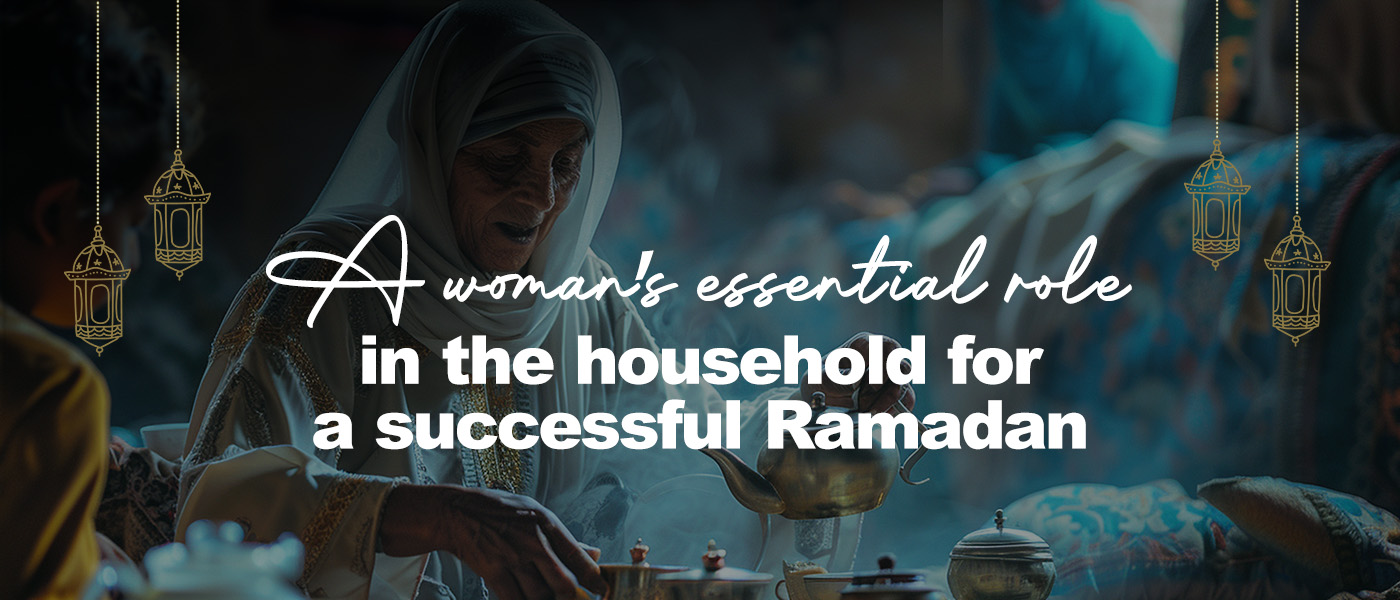
Ramadan is known as a month of intense spiritual focus. For Muslims, it’s a time to slow down, build character, and feel closer to everyone around us. They observe fasting from before sunrise until sunset, ramp up their prayers, give charity, and work on repairing and strengthening their relationship with Allah (SWT)—it’s an effort that touches every part of our individual and communal lives. However, the truth is that the whole rhythm of Ramadan, what makes it manageable for a month, and the positive memories it creates, is deeply dependent on women’s efforts. These aren’t minor favors or support on the side; their contributions are woven right into the spiritual fabric of the holy month. When we study Ramadan, not just through faith, but through the rules, the history, and how society works, we find a fuller, more complex story. The simple fact is that women are vital, they shape the month’s entire spiritual mood, its daily management, and its future for generations to come.
Studying and reflecting upon this topic is not praising women sentimentally, it is about clarifying a truth that has always existed but has rarely been articulated with analytical seriousness. Just as Ramadan demands a heightened awareness of the self, the community, and the unseen dimensions of worship, it also demands a more honest acknowledgment of the labor (spiritual, emotional, intellectual, and logistical), carried by women who enable the month to unfold as it does.
How Islamic ethics frames women’s work in Ramadan
Islamic discussions about Ramadan often focus on visible acts of worship such as taraweeh, Quran recitation, charity campaigns, and community iftars. However, The Quran itself never restricts worship to ritual performance. It describes believers as those who remember Allah (SWT), “[…] standing, sitting, and lying on their sides […].” (The Clear Quran®, 3:191)

a phrasing that captures the totality of daily life. Classical scholars interpreted this verse to mean that actions which facilitate devotion, whether through service, caregiving, or supporting the worship of others, fall under the broader umbrella of righteous deeds, and these are known as a’mal salihah.
When this framework is applied to the context of Ramadan, the significance of women’s work becomes immediately apparent. The preparation of suhoor, the coordination of family schedules, the management of children’s routines, the maintenance of a peaceful home environment, and the emotional labor required to keep a family steady under the physical strain of fasting, all of these tasks make the ritual obligations of Ramadan possible. They create the conditions under which others stand for taraweeh, read The Quran uninterrupted, or attend community programs.
In Islamic ethics, facilitating good is a recognized and rewarded category of worship. The Prophet (SAW) states, “The one who guides others to good is rewarded like the one who performs it.” (Sahih Muslim)

Scholars used this hadith to argue that enabling another person’s worship, through instruction, encouragement, or practical support, carries spiritual merit equal to performing the act oneself. Thus, women who create an organized, nurturing household environment during Ramadan are not performing secondary work, they are participating in a deeply rooted Islamic ethic where service directly contributes to religious life.
This reframes the discussion away from simplistic praise and toward theological accuracy that women’s contributions in Ramadan are not “helpful additions,” but instances or worship recognized explicitly and consistently within Islamic moral reasoning.
Women as architects of Ramadan’s religious memory
A serious academic analysis of Ramadan cannot proceed without acknowledging that women are primary sources for our knowledge of the month. This is not a symbolic gesture, it is a methodological reality. The hadith literature that describes the Prophet’s (SAW) Ramadan practices is profoundly shaped by the narrations of women. Lady Ayesha bint Abu Bakr alone transmitted detailed descriptions of the Prophet’s (SAW) nightly prayers, his pace of Quran recitation, the number of rak’ahs he prayed, his practices during the last ten nights, and his general spiritual disposition during the month. Without her reporting, the Ummah’s understanding of Ramadan would be fragmented and incomplete.
Similarly, Lady Umm Salma contributed significantly to the legal understanding of menstruation during Ramadan, clarifying rulings that continue to guide women’s practice today. Lady Asma bint Abu Bakr provided critical narrations on the timing of suhoor and the precise moment of iftar, shaping the fiqh positions that structure the daily fast. Even lesser-known female narrators contributed insights about charity, communal worship, domestic routines, and the Prophet’s (SAW) interactions with family members during the month.
From a historical perspective, it becomes impossible to treat women’s relationship with Ramadan as marginal. They were not only participants, they were authoritative observers and preservers of prophetic practice. The very details that Muslims rely on, the structure of qiyam, the etiquette of fasting, and the spiritual intensity of the last ten nights were transmitted through the intellectual labor of women who inhabited the Prophet’s (SAW) household and witnessed the intricacies of his devotional life.
When contemporary Muslims practice Ramadan according to prophetic tradition, they are unknowingly following paths illuminated by women’s scholarship. This is not rhetoric, it is a factual consequence of the historical record.

How Ramadan becomes gendered in practice
Beyond theology and history, the lived reality of Ramadan is deeply shaped by sociological patterns within Muslim households. Studies on domestic labor across cultures consistently show that women, even when working full-time jobs, perform the majority of childcare, meal preparation, and household management. During Ramadan, these responsibilities often increase rather than diminish. This creates a gendered experience of the month that differs significantly from its idealized portrayal. Men may have extended opportunities to attend taraweeh or i’tikaf, while women may be anchored at home by structural obligations that limit their access to communal worship.
Mothers of young children, for example, often experience fragmented nights of prayer, intermittent Quran time, and a constant negotiation between worship and caregiving. They may find themselves multitasking, listening to The Quran while preparing iftar, making dhikr while organizing the home, or praying only after the rest of the family has slept.
These disparities are not divinely mandated, they are cultural and logistical. Islam does not obligate women to carry the bulk of domestic work, but because they often do, their Ramadan experience becomes shaped by forms of devotion that are less visible but no less meaningful. Understanding this dynamic forces us to reconsider simplistic narratives about Ramadan being “the same month for everyone.” The month is the same, but its access differs according to one’s social responsibilities.
This sociological lens is essential for accurately analyzing women’s contributions. It demonstrates that their worship is often embedded within multi-layered roles such as being a caregiver, educator, emotional anchor, and logistical coordinator. Their devotional life occurs not in isolation but within the complex ecosystem of family life, which they frequently sustain.
Menstruation, divine exemptions, and misunderstood spiritual value
One of the most misunderstood aspects of women’s Ramadan experience is menstruation. Many women internalize a sense of guilt or spiritual interruption when they cannot fast or pray. Yet classical jurists consistently taught that menstruation is not a deficiency but a divine exemption rooted in mercy. The Prophet (SAW) corrected women who viewed it negatively, explaining that refraining from worship during menstruation is an act of obedience, not a spiritual loss. This point carries deeper theological significance. Islamic law frequently differentiates between ibadah ta’abbudiyyah, and worship rooted in moral or rational principles. Fasting belongs to the former category. Its spiritual value lies not in the physical act alone but in obedience to Allah’s (SWT) precise instructions regarding when it begins and when it ends, even when those instructions suspend the act temporarily.
Menstruation thus becomes a theological illustration of a larger Islamic principle, and that is obedience, not uniformity, defines devotion. A woman who refrains from fasting because Allah (SWT) commanded her to do so is fulfilling Ramadan’s purpose as fully as the person who fasts. Her worship is redirected, not diminished. She engages in dua, dhikr, service and reflection which are forms of devotion that The Quran and Sunnah consistently elevate. By correcting misconceptions around menstruation, we arrive at a more accurate, more inclusive, and more intellectually rigorous understanding of how women experience Ramadan’s spiritual landscape.
How women sustain the cultural memory of Ramadan
Perhaps the most far-reaching contribution of women lies in the transmission of Ramadan across generations. The stability of Ramadan as a global Muslim institution, its rituals, its meanings, its emotional resonance, it is not merely a product of fiqh books or scholarly lectures. It is sustained through consistent family-level practices, many of which are organized and maintained by women. Children often learn how to fast from their mothers. They observe the routines of Quran recitation, nighttime prayers, charity, and discipline within the home. They associate Ramadan with particular atmospheres, structured days, purposeful evenings, predictable rhythms that result from the daily efforts of the adults around them, particularly female caregivers. Sociologists or religion argue that rituals survive when they are embedded within daily life, transmitted consistently, and made meaningful through emotional association.
Women play a central role in this process. They create stability, continuity, and meaning whether through maintaining traditions, teaching values, or modeling discipline and gratitude. Their work ensures that Ramadan is not just a series of rituals but a recognizable spiritual landscape that children internalize and later pass on to their own families. This intergenerational function is neither accidental nor secondary. It is a critical mechanism through which Ramadan has remained a living, embodied practice for fourteen centuries.
The necessity of recognizing women’s central role in Ramadan
An honest and rigorous understanding of Ramadan must acknowledge women not as background participants but as central architecture of the month’s religious, social, and historical reality. Their labor enables worship, their scholarship preserves prophetic practice, their responsibilities shape the sociological structure of the month, and their teaching ensures its survival across generations. This is not an argument for praise, nor is it an emotional appeal. It is simply the conclusion that arises when Ramadan is studied with accuracy, intellectual integrity, and willingness to examine the full scope of what the month demands and what it requires to function.
Dua
O Allah! Allow us to recognize and honor every form of worship that You have made valuable, whether it is performed through prayer, fasting, service, or patience. Grant the women of our Ummah strength, sincerity, and reward for every visible and hidden act they carry in Ramadan.
Make their efforts a means of mercy for their families and a source of elevation for themselves.
O Allah! Enable our households to share responsibility with justice and compassion, and let every member of our community contribute to Ramadan in ways that are pleasing to You.
Ameen!