During this blessed month of spiritual cleansing, repentance, and steadfastness, consider making a donation towards our efforts in serving The Quran so that every individual, Muslim and non-Muslim, is able to connect with Allah (SWT) during His month. Whether it’s a one-time donation or Sadaqah Jariyah, no investment is small in the view of Allah (SWT) in the month of The Quran.
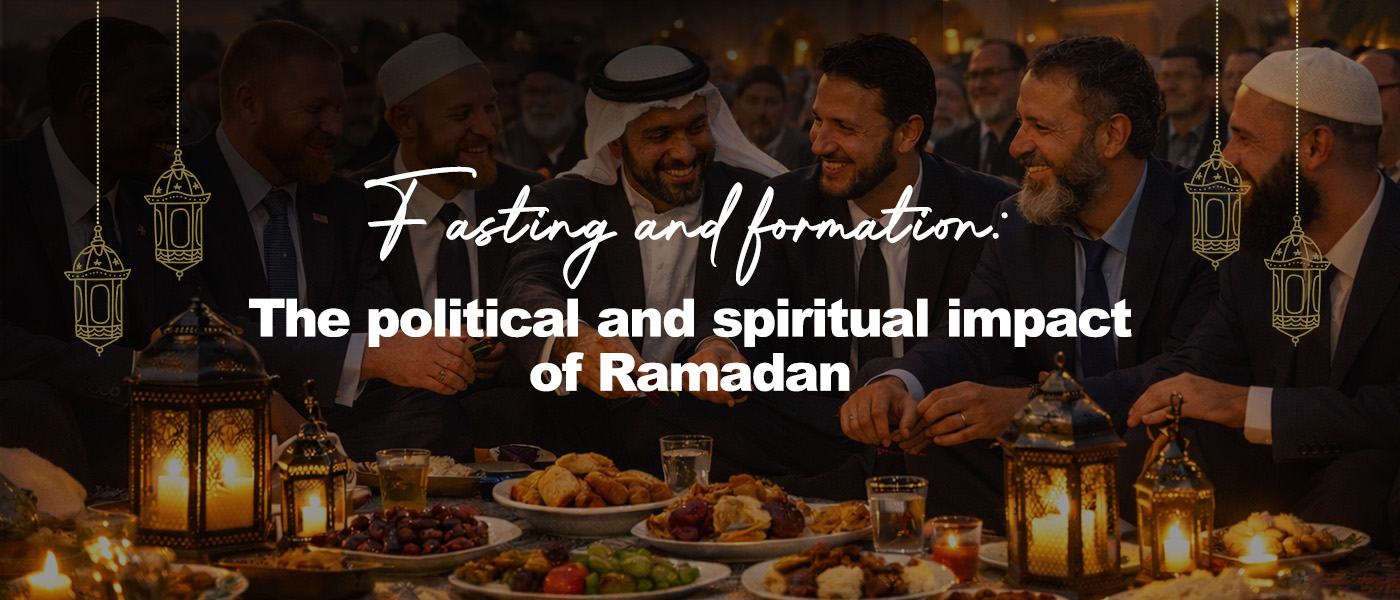
Ramadan, in the minds of many today, occupies a place primarily within the realm of individual spirituality where it’s a month associated with fasting, prayer, charity, and recitation of The Quran. However, such a reductionist view, while not incorrect in its emotional and devotional core, fails to account for the deeper historical, political, and civilizational role this sacred month has played in shaping the Muslim Ummah as a moral community, a repository of revealed guidance, and a bearer of spiritual and intellectual vision. To fully appreciate what Ramadan has meant for Muslim societies across centuries, we must lift our gaze beyond the familiar rituals that animate the personal lives of believers and instead situate this month within the broader context of Islamic civilization. A story that is marked by the descent of revelation, the formation of just societies, the confrontation with tyranny, and the renewal of communal identity.
It is not an exaggeration to say that Ramadan has served, time and again, as the calendar of awakening, a moment in the yearly rhythm of Islamic life when the hearts of believers and the conscience of entire communities have been reoriented toward divine purpose. Its influence is not limited to the inner state of the fasting individual, but rather extends into the collective psyche, ethical norms, intellectual productivity, and even the political mobilization of the Muslim world. In the article below, we will explore how Ramadan has functioned as a historical actor and civilizational force, breathing life into empires and reform movements, anchoring the Ummah through both crisis and triumph, and offering not only spiritual salvation but cultural cohesion and moral clarity.
Ramadan as the engine of civilizational consciousness
Any discussion about Ramadan’s historical and civilizational weight must begin not with its dietary restrictions or nightly rituals, but with the foundational reality that it is the month of Quranic revelation, an event that altered not merely the spiritual trajectories of individuals, but the moral and intellectual course of human civilization itself. Allah (SWT) says, “Ramadan is the month in which The Quran was revealed as a guide for humanity with clear proofs of guidance and the decisive authority […].” (The Clear Quran®, 2:185)
The Quran’s descent in Ramadan marks the point of departure between jahiliyyah and a new era of divine clarity, where revelation began to reconfigure not only how people prayed or fasted, but how they governed, traded, judged, and lived together as a society grounded in divine justice. In this sense, Ramadan inaugurated a civilizational paradigm where scripture shaped law, ethics, education, social relations, and global vision. The early Muslim community, particularly the generation of the Prophet (SAW) and the Sahabah, internalized this fusion between divine revelation and worldly reform, approaching Ramadan not as a temporary retreat from civic life, but as a moment to immerse in the scriptural source of their collective identity, readying themselves for both spiritual refinement and historical responsibility.
Moments that shaped history in the month of Ramadan
Across the centuries, Ramadan has not merely coincided with important historical events, rather, it has actively shaped the mental and moral landscape in which those events took place. Time and again, Ramadan has witnessed not just acts of devotion, but pivotal moments of confrontation, resistance, conquest, and renewal, reminding the Ummah that the sacred is never divorced from the worldly when the latter is guided by divine light.
- The Battle of Badr: On the 17th of Ramadan, in the second year after Hijrah, the Muslim Ummah faced its first existential threat in the form of the Qurayshi army at Badr. Despite being outnumbered and under-equipped, the believers achieved a victory that was not merely military, but moral and symbolic, a validation of the truth of the Prophet’s (SAW) mission, and a declaration that tawheed was no longer confined to private belief, but now had a public and political presence in the Arabian peninsula.
Allah (SWT) said in The Quran, “Indeed, Allah made you victorious at Badr when you were vastly outnumbered. So be mindful of Allah, perhaps you will be grateful.” (The Clear Quran®, 3:123)
The fact that this confrontation occurred in Ramadan is not incidental. It is a reflection of how fasting, heightened consciousness, and Quranic immersion can give rise to courage, sacrifice, and transcendent commitment.
- The Conquest of Makkah: When the Prophet (SAW) re-entered Makkah during Ramadan eight years after Hijrah, he did so not with vengeance, but with humility and mercy, declaring general amnesty and restoring the Ka’bah to its monotheistic purpose. This moment presents a civilizational maturity, where Islamic leadership was not defined by tribal retaliation or military glory, but by spiritual authority, forgiveness, and institutional reform.
Allah (SWT) has said, “And declare, ‘The truth has come and falsehood has vanished. Indeed, falsehood is bound to vanish.” (The Clear Quran®, 17:81)

The conquest was as much about restoring civilizational order as it was about reclaiming territory, and Ramadan offered the ideal spiritual context for such a transformative moment.
- The Battle of ‘Ayn Jalut: This was a battle in which the Mamluks halted the seemingly unstoppable Mongol advance, also occurred in Ramadan, demonstrating again how this month has historically brought out not only personal piety but communal resilience and institutional revival. Even in modern times, Ramadan has often coincided with revolutions, resistance movements, and ideological awakenings, serving as a reminder that The Quran’s transformative power is never limited to the page or the heart, it inevitably flows into the world, challenging tyranny and uplifting those who bear witness to truth.
Ramadan’s impact on public morality and culture
Ramadan, as practiced across Muslim lands, does more than inspire individual taqwa, it initiates an annual moral recalibration of society, temporarily reshaping economic rhythms, media content, public behavior, and community life in ways that reflect the values of self-restraint, generosity, and spiritual awareness. It is perhaps one of the only periods in modern life where entire cities slow down their consumption, alter their business hours, increase charity distributions, and publicly emphasize prayer and ethical conduct. The act of fasting itself becomes a public declaration of faith, not in the form of spectacle, but as a shared commitment to divine discipline.
The Prophet (SAW) captured this social dimension in his saying, “When Ramadan begins, the gates of Paradise are opened, the gates of Hell are closed, and the devils are chained.” (Sahih Bukhari)
While this refers to unseen realities, its societal implications are evident. Vice decreases, virtue increases, and a collective atmosphere of remembrance prevails, however briefly. Ramadan provides the Muslim world with an annual opportunity to rediscover what a faith-guided society might look like, even if imperfectly.
Ramadan and the intellectual legacy of Islamic civilization
One of the more profound, though less discussed, effects of Ramadan as a civilizational force lies in its impact on the intellectual rhythms of Islamic scholarship and learning. Unlike modern educational paradigms that separate spiritual devotion from scholarly pursuit, the classical Islamic world saw the quest for knowledge as an act of ibadah, and nowhere was this synthesis more alive than in the sacred month of Ramadan. In the great cities of learning, Baghdad, Cairo, Damascus, Fez, Nishapur, and others, Ramadan was a time when halaqat of tafsir, collections of hadith, and advanced texts in fiqh, theology, and Arabic linguistics were studied with renewed vigor.
The nights of Ramadan were illuminated not only by the taraweeeh prayer, but by the turning of pages, the murmur of recitation, and the lively exchange between students and their teachers, all of whom viewed the month as a period uniquely blessed for the sharpening of the heart and mind alike. Imam Malik famously closed his books of fiqh during Ramadan to devote himself solely to The Quran, while Imam al-Shafi’i was reported to complete The Quran 60 times during the month, reflecting and understanding that the foundational source of all legal and moral guidance must be revisited intensely and communally during this sacred time. Ramadan, in this light, emerges not just as a period of heightened piety, but as an intellectual incubator for Islamic civilization, feeding the minds of jurists, theologians, philosophers, poets, and social critics whose work would define Islamic thought for centuries to come.
Ramadan in the face of oppression
Throughout history, and especially in moments when Muslim communities have been subjected to oppression, colonization, or systematic marginalization, Ramadan has served as more than a season of religious observance, it has functioned as a reservoir of dignity, resolve, and moral defiance. The act of fasting, though deeply spiritual, also carries with it a form of quiet protest (a rejection of indulgence, a cultivation of endurance, and a visible affirmation of Islamic identity in the face of forces that seek to erase it). In colonized lands, the call to prayer and the communal breaking of the fast became acts of preservation, reminders that no political power could extinguish the soul of a people whose hearts were aligned with divine rhythms.
In times of war and displacement, Ramadan has offered not only spiritual solace, but communal solidarity, as believers gathered around what little food they could find, reciting the same verses revealed to a people centuries earlier under siege, persecution, and exile. From Bosnia to Palestine, from Kashmir to Myanmar, the month of Ramadan continues to be observed by those who fast not only out of devotion, but as a testament to their resilience, reminding the Ummah that Islam lives wherever its people remember Allah (SWT), even when the world forgets them.
A global pulse for the unity of the Ummah
In a time when the global Muslim community is fragmented by geopolitical borders, ethnic divisions, linguistic differences, and ideological disagreements, Ramadan stands out as one of the few remaining experiences that unites the Ummah across time zones and continents. It is during this month that Muslims rise before dawn, abstain through daylight, gather for iftar, and stand in nightly prayers, all oriented not only toward the same physical qiblah, but toward a shared sense of purpose, purification, and proximity to Allah (SWT).
This synchronization of spiritual life across the globe is not merely symbolic, it is deeply transformative. It reminds us that the Ummah, despite its wounds and weaknesses, still shares a living heartbeat, one that pulses most vividly in Ramadan. As the Prophet (SAW) has taught us, “The believers are like a single body: if one part of it is afflicted, the rest of the body responds with sleeplessness and fever.” (Sahih Muslim)
Ramadan revives this body, not only through communal prayer and shared fasting, but through a collective moral awakening that spans cultures, languages, and generations.
If Islamic civilization can be described as the historical unfolding of Quranic values in real time, through institutions, scholarship, governance, architecture, literature, and law, then Ramadan must be seen as one of its primary engines. A time when revelation was first sent down, when hearts were shaped for divine obedience, and when the Muslim community was trained to synchronize its inner life with the higher order of Allah’s (SWT) will. More than a season of devotion, Ramadan has functioned as a period of societal renewal, communal recalibration, and spiritual resistance, a time when believers not only fasted, but confronted the darkness around them, reclaimed their dignity, expanded their minds, and affirmed their allegiance to something far greater than worldly powers.
To return to Ramadan is to return to The Quran. To return to The Quran is to return to justice, and to return to justice is to rekindle the light of civilization rooted in worship, knowledge, and mercy. In every age, and especially in ours, Ramadan reminds us that revival is not a fantasy of the past, it is a living possibility, waiting to be rekindled, one fast, one verse, and one sincere believer at a time.
Dua
O Allah! Let this Ramadan be a renewal of our covenant with You, and the beginning of an awakening that stirs our hearts and our Ummah.
Let it be a month in which we once again raise our heads by Your Quran, just as You once raised a people by it, and rebuild through it what has collapsed within our character, our unity, and our identity.
O Allah! Make us in this month among the people of taqwa, truthfulness, and humility, among those who carry Your message upon the earth, who uphold Your commands, who elevate truth, who show mercy to Your creation, and who strive to reform what has become corrupt in this Ummah.
Ameen!