
During this blessed month of spiritual cleansing, repentance, and steadfastness, consider making a donation towards our efforts in serving The Quran so that every individual, Muslim and non-Muslim, is able to connect with Allah (SWT) during His month. Whether it’s a one-time donation or Sadaqah Jariyah, no investment is small in the view of Allah (SWT) in the month of The Quran.
Join us live each night for Taraweeh from Masjid Furqaan Bolingbrook on Facebook and YouTube. If you cannot be with us in person, stay connected from wherever you are and let the recitation of The Quran fill your home with the spirit of Ramadan. Tune in, share with family and friends, and be part of a community that stands together in prayer, reflection, and mercy every single night.
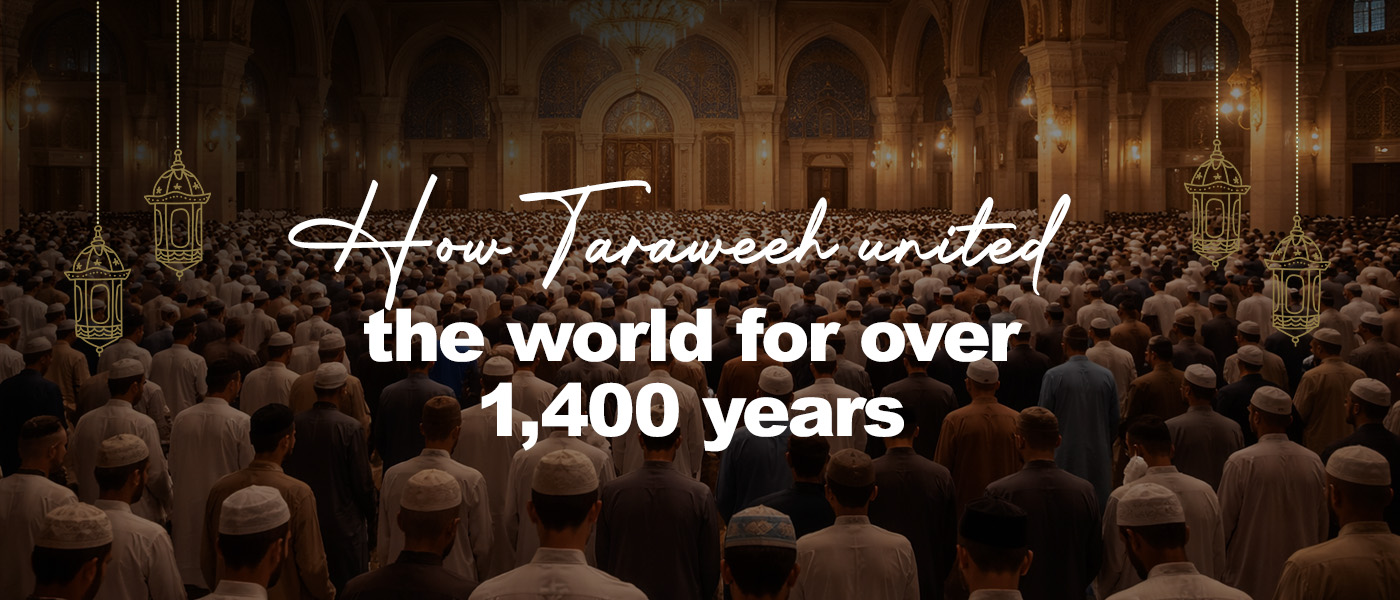
In the collective memory of the Muslim Ummah, few acts of worship hold such a profound place during the month of Ramadan such as Salat al-Taraweeh. For many, it is the spiritual routine of the month where every night, you immerse yourself in The Quran in an extended night of worship with the Divine, marking it both a social and devotional encounter. Yet beyond its familiarity lies a rich and complex history, spanning from the earliest days of revelation to the lived Sunnah of the Prophet (SAW), the ijtihad of the rightly guided Caliphs, and the ongoing negotiations between legal precedent and spiritual experience. To explore the history of Taraweeh is to explore how early Muslims lived revelation, interpreted prophetic examples, and responded, with deep care, to the balance between form and essence in worship. The very concept of night prayer, qiyam al-layl, predates Taraweeh as we know it.
It is foundational to The Quranic vision of spiritual refinement and nearness to Allah (SWT). In fact, one of the earliest commands revealed to the Prophet (SAW) came in the form of an injunction to pray during the night. The beginning of Surah Al-Muzammil, widely acknowledged as among the earliest revelations chronologically, opens with the address, “O you, wrapped in your clothes! Stand all night in prayer except a little—pray half the night, or a little less, or a little more—and recite the Quran properly in a measured way.” (The Clear Quran®, 73:1-4)
This command, according to the early mufassirun, was initially obligatory upon the Prophet (SAW) and a small group of believers who followed him. The purpose of this rigorous nightly standing was not merely devotion in the abstract, but preparation, for what the verse calls a “weighty word” to be revealed. The night, described as ashaddu wat’an and aqwamu qilan was thus chosen by Allah (SWT) as the terrain upon which the soul of the Prophet (SAW) would be shaped by revelation. This form of night worship was not limited to Ramadan. It was a regular, year-round discipline, and the Prophet (SAW) continued it throughout his life, even after it was no longer mandated for the believers.
In a well-known hadith, Lady Ayesha bint Abu Bakr (RA) relates that the Prophet (SAW) would stand for countless hours in the night to the extent that his feet would swell, and when she asked him why he (SAW) exerted himself so much when his past and future sins had already been forgiven, he (SAW) replied, “Should I not be a grateful servant?” (Sahih Bukhari) Yet it is in the month of Ramadan that this standing takes on a unique and intensified character. The Quran describes Ramadan as the month in which the revelation first descended, “Ramadan is the month in which the Quran was revealed as a guide for humanity with clear proofs of guidance and the decisive authority.” (The Clear Quran®, 2:185)
And we know that, each year, the Prophet (SAW) would review The Quran with Jibraeel (AS) during Ramadan. In the final year of his life, this review was done twice, according to Sahih Bukhari. This practice of deep Quranic immersion in the nights of Ramadan formed the spiritual backdrop to what would become Taraweeh, an extended, communal form of qiyam al-layl specific to this sacred month. The word Taraweeh itself is not used in The Quran or the early hadith as its original term. Linguistically, it is the plural of tarawihah, and this is derived from the root ر-و-ح which carries meanings of rest, ease, and comfort. Early Muslims would take brief pauses after every four rakat due to the length of the prayer, and so this term came to refer to the entire practice, not merely as a technical label, but as a spiritual description of what the prayer offered: rest for the soul through communion with The Quran.
During the lifetime of the Prophet (SAW), Taraweeh was practiced, but not institutionalized. Its form was spontaneous, its gathering organic, and its performance marked by both presence and caution. One of the clearest narrations in this regard comes from Lady Ayesha bint Abu Bakr (RA) who recounts, “The Messenger of Allah prayed in the mosque one night, and people followed him in prayer. Then he prayed the next night, and more people gathered. Then on the third or fourth night, the mosque was full, and the Messenger of Allah did not come out to them. In the morning, he said, ‘Nothing prevented me from coming out to you except that I feared that it would be made obligatory upon you.’” (Sahih Bukhari)
This narration is critical in understanding both the mercy of the Prophet (SAW) and the deliberate restraint with which he introduced devotional practices. His withdrawal from leading Taraweeh, despite its clear benefit, was rooted in his prophetic concern that the Ummah not be overburdened. This concern is consistent with Allah’s (SWT) broader message, “Strive for the cause of Allah in the way He deserves, for it is He who has chosen you, and laid upon you no hardship in the religion—the way of your forefather Abraham.” (The Clear Quran®, 22:78)
Thus, while Taraweeh in congregation was performed during his lifetime, it remained a non-obligatory, non-institutionalized Sunnah.
Following the Prophet’s (SAW) departure, this pattern continued during the caliphate of Abu Bakr as-Siddiq (RA). The Ummah was still in a state of mourning and early consolidation. The Quran was being collected, false prophets were being dealt with, and the spirit of worship remained focused on what was known and established. Taraweeh remained practiced, but as it had been individually, or in small, informal groups. It would be under the caliphate of Umar ibn al-Khattab (RA) that the prayer of Taraweeh would take on its now-familiar communal structure.
Umar ibn al-Khattab (RA) and the institutionalization of a prophetic legacy
When Umar ibn al-Khattab (RA) assumed the mantle of leadership, the Muslim community had entered a new phase of its existence. Islam was no longer a fragile revelation confined to the Arabian Peninsula. It had become a civilizational force, expanding beyond its birthplace into Persia, Syria, Egypt, and beyond. With this expansion came a profound transformation in the nature of the Ummah itself. The community was no longer a small body of companions who had lived in the direct presence of the Prophet (SAW). It was now a growing, diverse population of believers, many of whom had never seen him, and many of whom were new to the routines of Islamic worship. It was in this context that Umar ibn al-Khattab (RA) demonstrated the genius for which he is remembered in Islamic history: to have an ability to preserve the spirit of the Sunnah while responding intelligently to the changing realities of the Ummah. His approach was neither rigid literalism nor reckless innovation. It was, rather, an embodiment of fiqh al-waqi, a deep understanding of context guided by reverence for revelation.
One night in Ramadan, Umar ibn al-Khattab (RA) entered the masjid of the Prophet (SAW) and observed a scene that was outwardly pious, yet inwardly fragmented. People were scattered throughout the mosque. Some prayed alone. Others prayed in small clusters behind different reciters. Every group was engaged in worship, yet the collective experience lacked coherence. The Quran was being recited, but its impact was dispersed. The Ummah was present, but not united. The narrator, Abd al-Rahman ibn Abd al-Qari describes the moment by saying, “I went out one night in Ramadan with Umar ibn al-Khattab to the mosque, and the people were praying in separate groups. A man would be praying alone, and another man would be praying with a small group behind him. Umar said, ‘By Allah, I think it would be better if I gathered them behind one reciter.’ Then he resolved to do so and gathered them behind Ubayy ibn Ka’b.” (Sahih Bukhari)
This was not a casual decision. Umar ibn al-Khattab (RA) was acutely aware of the Prophet’s (SAW) earlier withdrawal from congregational night prayer. He knew that the Messenger of Allah (SAW) had refrained from institutionalizing Taraweeh out of fear that it would become obligatory. However, that fear was tied to the presence of revelation itself. As long as the Prophet (SAW) lived, the possibility of new obligation remained. With his passing, that door was closed forever. No act of worship could now become fard without prophetic legislation. What Umar ibn al-Khattab (RA) recognized, therefore, was that the reason behind the Prophet’s (SAW) restraint no longer existed. The Sunnah had not been abandoned, its underlying wisdom had simply reached a new stage. The mercy of the Prophet (SAW) had preserved flexibility for the Ummah. The insight of Umar ibn al-Khatab (RA) now transformed that flexibility into structured benefit.
When he later returned to the mosque and saw the believers standing in long, unified rows behind a single reciter, he uttered the words that have echoed through Islamic discourse ever since, “What an excellent innovation this is.” This statement cannot be understood through a superficial reading of the term bid’ah. In Islamic legal theory, bid’ah is not a monolithic category. Linguistically and legally, it refers to anything newly introduced; however, remember that the meaning differs due to context. It refers to introducing something into the religion that has no basis in revelation. Umar ibn al-Khattab (RA) was using the word in its linguistic sense, not its condemnatory legal one. The act itself—standing in night prayer during Ramadan in congregation—was already rooted in the Sunnah. What was “new” was its organization as a stable, communal institution.
Classical scholars understood this clearly. Imam al-Shafi’i famously said, “Innovations are of two types: that which contradicts the Quran, Sunnah, or consensus—this is misguidance, and that which is introduced of goodness and does not contradict any of these—this is a praiseworthy innovation.”
Taraweeh under Umar ibn al-Khattab (RA) belongs firmly to the second category. It was not a theological addition, nor a ritual invention. It was a revival and preservation of a prophetic practice, adapted for a community that had outgrown its original informality. Umar ibn al-Khattab’s (RA) choice of Ubayy ibn Ka’b as the imam was itself a profound statement. Ubayy ibn Ka’b was among the foremost authorities on The Quran. The Prophet (SAW) said, “Take the Quran from four: From Abdullah ibn Mas’uh, Salim the freed slave of Abu Hudhayfah, Mu’adh ibn Jabal, and Ubayy ibn Ka’b.” (Sahih Bukhari)
In another narration, the Prophet (SAW) told Ubayy ibn Ka’b that Allah (SWT) had commanded him to recite The Quran to him by name, and this was an honor that caused Ubayy ibn Ka’b to weep. To place such a man at the head of the community in Taraweeh was to ensure that this prayer would remain, at its core, a Quranic experience, not a hollow routine. From this point onward, Taraweeh became a defining feature of Ramadan in the public life of Muslims. It was no longer merely an individual act of devotion. It became a collective encounter with revelation, in which entire communities would stand together night after night, listening to the words that once descended upon a solitary man in a cave. This transformation also reshaped the spiritual psychology of the Ummah.
Taraweeh became a means by which ordinary believers, farmers, merchants, soldiers, women, and children, could participate in the same routine of Quranic immersion that had once been the private domain of the Prophet (SAW). Through this prayer, the night of the believer became a mirror of the night of revelation.

Yet even as Taraweeh became institutionalized, its voluntary nature was preserved. It was never framed as obligatory. It remained an invitation, not a burden. The Prophet’s (SAW) mercy continued to breathe through it, even Umar ibn al-Khattab’s (RA) vision gave it form.

The debate over the number of rak’at and the spirit of diversity in worship
From the earliest days of Taraweeh in congregation, there arose legitimate differences in how many units should be prayed. These differences were not signs of division. They were, rather, the natural outcome of a rich tradition that valued the principle of divine flexibility, the complexity of prophetic practice, and the application of reasoned ijtihad in the absence of definitive legislation. To understand this issue, we must first return to a narration reported by Lady Ayesha bint Abu Bakr (RA) in both Sahih Bukhari and Sahih Muslim where she says, “The Prophet never exceeded eleven rak’at in Ramadan or outside of it. He would pray four—do not ask how beautiful or how long they were—then another four—and do not ask how beautiful or how long they were—and then he would pray three.” (Sahih Bukhari) This narration is central to those scholars and schools who advocate for eight rak’at of Taraweeh followed by three rak’at of Witr, citing it as the clearest example of the Prophet’s (SAW) nightly prayer routine.
However, what must be understood, and what many classical scholars emphasized, is that this narration describes what the Prophet (SAW) consistently practiced in his private prayer, not necessarily what he (SAW) legislated for the Ummah in a congregational or institutional setting. This distinction is crucial. When Umar ibn al-Khattab (RA) appointed Ubayy ibn Ka’b to lead the Muslims in Ramadan prayer, the number of rak’at reported in the early sources is 20 rak’at, followed by three for Witr. The Muwatta of Imam Malik includes reports of this practice during the caliphate of Umar ibn Al-Khattab (RA), and it became the dominant practice in Makkah, Madinah, and the broader Islamic world thereafter. Some reports even mention that in Makkah, during the time of the Tabi’un, the people would pray 36 rak’at, with breaks and pauses in between, reflecting the spiritual appetite and stamina of the community.
The question then arises: was this a deviation from the Prophet’s (SAW) Sunnah? The answer, according to the vast majority of classical scholars, is no. Rather, they understood the Prophet’s (SAW) Sunnah to include both his consistent practice and the allowances he (SAW) left open for the Ummah. Since he (SAW) never fixed a specific number of qiyam al-layl in a prescriptive manner, the companions understood that the number of rak’at was open to discretion, based on the ability of the people and the length of the recitation. Imam al-Nawawi explains, “The correct view, known and chosen by the majority, is that there is no set number for night prayer. It is permissible to pray a little or a lot, and there is no limit.” (al-Majmu)
Likewise, Shaykh al-Islam ibn Taymiyyah comments, “The Prophet (SAW) did not limit the number of rak’at for night prayer in Ramadan or outside of it. He prayed in various numbers. When he prayed with his companions in Ramadan, he did not specify a number. Therefore, both 20 rak’at and more or less are permissible.” (Majmu al-Fatwa)
Most importantly, recorded as Sahih in Sunan Abi Dawud, the Prophet (SAW) said, “I counsel you to have taqwa (fear) of Allah, and to listen and obey [your leader], even if a slave were to become your ameer. Verily he among you who lives long will see great controversy, so you must keep to my Sunnah and to the Sunnah of the Khulafa ar-Rashideen (the rightly guided caliphs), those who guide to the right way.”
This diversity reflects something essential about the nature of Islamic worship: its adaptability. Acts of devotion are not only about mechanical repetition, they are also about accessibility, depth, and sincerity. The Prophet (SAW) himself encouraged this ethos when he (SAW) said, “Pray as much as you are able.” (Sahih Bukhari)

This spirit allowed early Muslim communities to adjust their worship based on time, energy, climate, and communal needs, all without violating the Sunnah.
It is important to note, however, that the debate over rak’at was never central to the spiritual intent of Taraweeh. The real concern of the early generations was not how many units were prayed, but how present the heart was during them. In a society now often fragmented by debates that lack both context and humility, the classical approach offers a sobering reminder that the legal scholars disagreed, but they did so with reverence, with knowledge, and without accusing each other of abandoning the Sunnah. In that light, whether one prays 8, 20, or 36, the measure of the prayer is not its quantity, but its quality. This is especially true in Ramadan, when the believer stands not merely in form, but in sacred remembrance of a night when The Quran descended, “Indeed, it is We Who sent This Quran down on the Night of Glory. And what will make you realize what the Night of Glory is? The Night of Glory is better than a thousand months.” (The Clear Quran®, 97:1-3)
A legacy that lives in the modern world
In every generation, the Ummah has carried the torch of Taraweeh from the desert masajid of Madinah to the minarets of Istanbul, the quiet villages of Mali, the night markets of Kuala Lumpur, and the makeshift prayer rooms of diaspora communities around the globe. And yet, as the centuries have passed, the world in which we perform Taraweeh has changed in profound ways. The question now is not simply how Taraweeh began, but what it means to uphold it today. In an age of unprecedented speed, noise, and distraction, the night prayer stands as a counter-cultural act. It demands slowness in a culture of urgency, silence in an era of constant notification, and humility in a time of curated self-image. Taraweeh pulls the believer out of the day’s mental clutter and places them, however briefly, in a space of spiritual clarity. It does not require elaborate knowledge, material wealth, or even perfect focus – only presence. Only a willingness to stand.
For many modern Muslims, especially those living in urban or secular contexts, Taraweeh has become one of the only sustained communal acts of ibadah they engage in all year. It may be the first time a young Muslim hears The Quran recited aloud for more than 10 minutes. It may be the only time a new Muslim feels part of a tightly knit community. For elders, it may be a yearly return to rhythms long embedded in the soul, familiar voices, familiar rows, and familiar pauses between rak’at. And yet, the risk in our time is not abandonment of Taraweeh, but its gradual emptying of meaning. It is now possible to attend Taraweeh and leave unmoved, to stand without listening, to race through rak’at without reflection, to treat it as an endurance exercise or a cultural event rather than a spiritual anchor. The beauty of Taraweeh lies not in its pace or programming, but in the intention behind it.
This is where the leadership of our communities matters. When imams choose meaningful recitation over speed, when masajid create space for understanding The Quran, when families prepare spiritually for Ramadan instead of reacting to it, Taraweeh becomes more than a tradition, it becomes a bridge between the self and The Quran, between individuals and community, and between our lives and the prophetic example. The strength of Taraweeh has always been its openness. Whether prayed in 8 rak’at or 20, in a majestic masjid or a small living room, with an experienced hafiz or a struggling beginner, it remains valid, beloved, and full of reward. This flexibility is not a flaw but a mercy, and perhaps one of the secrets of its longevity. As long as there are hearts that seek Allah (SWT) in the night, Taraweeh will not disappear.
The prayer that refuses to die
Every year, when the first night of Ramadan begins and the call to Isha ends, something extraordinary happens. Across continents and time zones, in every language and shade and condition, the Ummah stands.

Some for the full prayer, some for a few rak’at, some at home, others behind a gifted reciter, but all in some way re-enacting a legacy that began with the trembling of a man in a cave.
Taraweeh is not simply a ritual handed down. It is a living act of collective memory, a nightly statement that The Quran still matters, that worship still moves people, that even in a world built to distract, the believer can still choose to return, and as long as those rows continue to form, tired feed, heavy eyes, and all, the Ummah is not lost.
Dua
O Allah (SWT)! Make our standing in Ramadan sincere for Your sake. Use us in Your worship, and do not deprive us of the sweetness of standing before You.
O Allah (SWT)! Make The Quran the spring of our hearts, the light of our chests, the remover of our grief, and the reliever of our worries.
O Allah (SWT)! Make us among the People of The Quran, Your special people, and raise us through it to the ranks of the righteous.
Ameen!