During this blessed month of spiritual cleansing, repentance, and steadfastness, consider making a donation towards our efforts in serving The Quran so that every individual, Muslim and non-Muslim, is able to connect with Allah (SWT) during His month. Whether it’s a one-time donation or Sadaqah Jariyah, no investment is small in the view of Allah (SWT) in the month of The Quran.
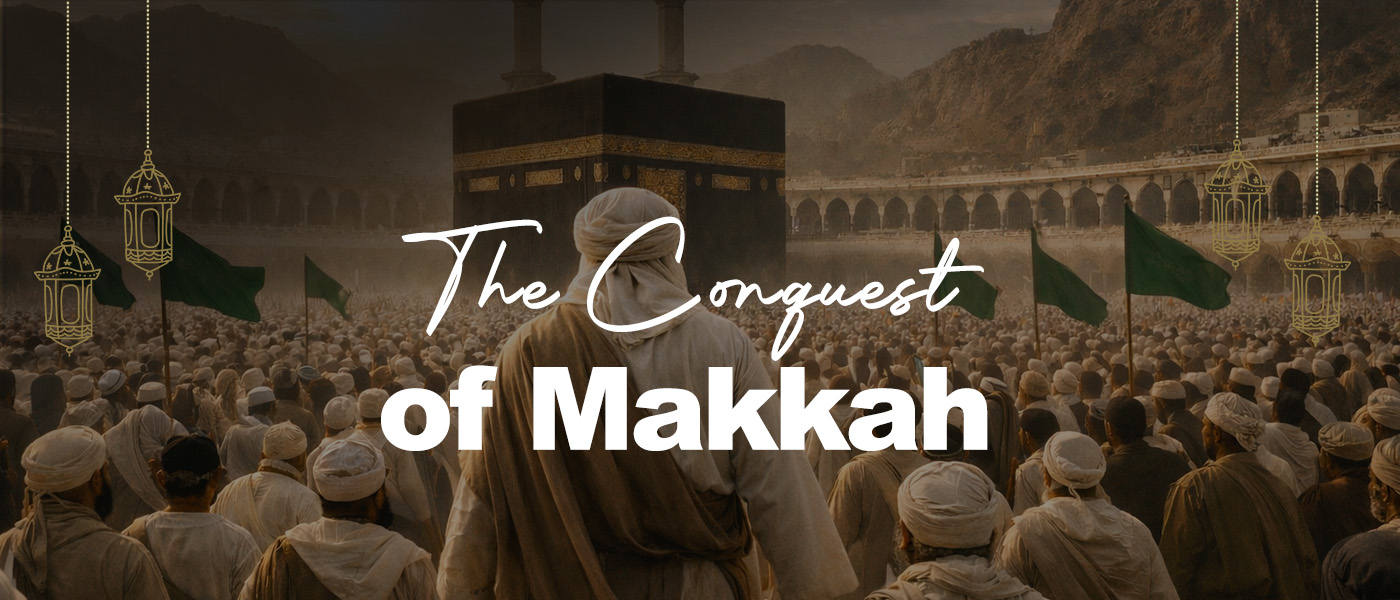
There are certain events in the sirah of the Prophet (SAW) that every Muslim knows by heart, yet few pause to examine in depth. The Conquest of Makkah is one of them. This monumental event in early Islamic history is often remembered as the moment when the Prophet (SAW) returned to his birthplace as the head of 10,000 believers and the idols around the Ka’bah were finally removed
, but when we slow down and study it carefully, we begin to see that this was not only a military triumph and political consolidation, but also a defining moment in which the moral claims of Islam were tested under the most difficult of circumstances (absolute power). For more than 20 years prior to this moment, the relationship between the Prophet (SAW) and the Quraysh had been shaped by rejection, persecution, exile, and war. The early Muslims had been mocked, beaten, boycotted, imprisoned, and some even killed. The Prophet (SAW) himself had been called a liar, a poet, a sorcerer, and worse.
He (SAW) had witnessed members of his own clan turn against him and companions tortured in the scorching heat of Makkah. Eventually, he (SAW) was forced to leave the city he (SAW) loved. When he (SAW) stood at the edge of Makkah years later with an army large enough to ensure its surrender, the question was no longer whether he (SAW) would prevail, but how he (SAW) would use that victory.
To understand the significance of this moment, we must remember that the conquest did not come suddenly or impulsively. It was preceded by the Treaty of Hudaybiyyah, an agreement that, at the time, appeared to many companions as painfully one-sided. Yet Allah (SWT) described that treaty as a “clear victory” in Surah Al-Fath, teaching the believers that strength is not always displayed in confrontation, and that restraint, patience, and strategic foresight can be more transformative than immediate retaliation. The treaty established a fragile peace between Madinah and the Quraysh, and during that period Islam spread with remarkable speed across Arabia, not through coercion but through exposure and interaction. When the Quraysh violated that treaty by supporting an attack on Banu Khuza’ah, who were allied with the Muslims, the march toward Makkah became not an act of aggression, but a response grounded in covenantal responsibility. This detail is important because it shows that the Prophet (SAW) did not frame his campaign as revenge for past wrongs, even though he (SAW) had every human reason to do so. Instead, the matter was approached within a moral and legal framework, reinforcing the idea that the emerging Muslim polity was bound by agreements and principles, not by tribal impulse.
The entry into Makkah itself remains as one of the most studied scenes in Islamic history. Rather than entering with spectacle or arrogance, the Prophet (SAW) lowered his head in humility, so much so that the narrations describe his beard nearly touching his saddle. There was no triumphant boast, no public settling of personal scores, no display of humiliation toward those who had once humiliated him. As he (SAW) approached the Ka’bah and began removing the idols, he (SAW) recited the verse, “And declare, ‘The truth has come and falsehood has vanished. Indeed, falsehood is bound to vanish.’” (The Clear Quran®, 17:81)

This was not only the cleaning of a sacred space from physical idols, but the reorientation of Makkah’s identity itself. The city that had once been the stronghold of resistance to Tawheed was now becoming the spiritual center of a unified Ummah. Perhaps the most striking dimension of the conquest, however, was the general amnesty. The Prophet (SAW) gathered the people of Makkah, many of whom had actively persecuted him and his companions, and asked what they expected from him. When they expressed hope in his nobility, he (SAW) replied with words that echoed the mercy of Prophet Yusuf (AS), “There is no blame upon you today, go, for you are free.” In that moment, cycles of vengeance that had defined Arabian tribal politics for generations was decisively broken. Authority was established, but it was not weaponized for mass reprisal.
For a Muslim reflecting on this event, especially in a time when discussions of power, justice, and governance often become polarized or reactionary, Fath Makkah offers a model that is neither naive nor harsh. It demonstrates that strength is not the defeat of an enemy alone, but the preservation of principle when one has the upper hand. As we move forward in this article, we will examine the conquest as a layered event with legal, theological, and ethical implications.
Hudaybiyyah: The strategic patience that made the conquest possible
No study of the Conquest of Makkah can begin in the eighth year after Hijrah without first returning to the sixth, because Fath Makkah was not an isolated eruption of strength but the natural outcome of a carefully navigated political movement two years earlier at Hudaybiyyah. To detach the conquest from the treaty that preceded it is to misunderstand both the prophetic method and the divine wisdom that shaped events. In the sixth year after Hijrah, the Prophet (SAW) set out from Madinah with approximately 1,400 hundred companions, dressed in ihram and carrying sacrificial animals, intending only to perform umrah. This detail is critical because it establishes the moral posture of the Muslims at that moment, they were not mobilized for war, nor were they advancing with a military objective, but rather approaching the Sacred Sanctuary in the spirit of worship. Quraysh, however, perceived this movement through the lens of suspicion and pride, and they barred the Muslims from entering Makkah, unwilling to allow Prophet Muhammad (SAW) and his followers the symbolic legitimacy of pilgrimage.
The negotiations that followed that Hudaybiyyah tested the emotional discipline of the believers in ways that open warfare had not. The terms of the treaty appeared, at least on the surface, to favor Quraysh. Among the conditions was that the Muslims would return to Madinah without performing umrah that year, and that if a Makkan embraced Islam and fled to Madinah without the permission of his guardian, he would be returned, whereas a Muslim who defected to Quraysh would not be sent back. Even the wording of the treaty felt heavy to some of the companions. When Ali ibn Abu Talib (RA) was instructed to write “Muhammad, the Messenger of Allah,” the Makkan negotiator objected and demanded that only “Muhammad ibn Abdullah” be written, refusing to recognize his prophethood.
For many of the companions, especially those whose faith had been forged in persecution and battle, these concessions were difficult to accept. Umar ibn al-Khattab (RA) famously questioned how they could agree to terms that seemed to diminish their standing. Yet the Prophet (SAW) remained composed, confident not in immediate optics but in long-term outcomes, and it was in this atmosphere of apparent concession that Surah Al-Fath was revealed, “Indeed, We have granted you a clear triumph ˹O Prophet˺ […].” (The Clear Quran®, 48:1)
The Quranic description of the treaty as a “clear victory” invites reflection. There were no battlefield triumphs, no captured territories, and no spoils of war. Instead, there was a written agreement and a return to Madinah. Yet from a strategic perspective, the treaty accomplished what years of confrontation had not. It secured a 10-year truce between Madinah and Quraysh, effectively acknowledging the Muslims as a legitimate political entity. It reduced the constant threat from Makkah, allowing the Prophet (SAW) to redirect attention to other destabilizing forces in the region. Most importantly, it created space. In that space, Islam spread with remarkable speed. Freed from the constant state of war with Quraysh, tribes across Arabia began to reassess their stance toward the Prophet (SAW). Delegations came to Madinah not as enemies, but as inquirers. People who had previously viewed Islam through the distorted lens of Makkan propaganda were now able to observe the Muslim community directly. Historians of the sirah note that in the two years following Hudaybiyyah, more people embraced Islam than in the many years before it.

What had looked like compromise proved to be expansion.
The treaty also revealed something essential about prophetic leadership: a willingness to absorb short-term criticism for long-term stability. The Prophet (SAW) understood that dignity does not lie in refusing negotiation, nor does strength require perpetual confrontation. By accepting terms that seemed outwardly unequal, he shifted the moral burden onto the Quraysh. As long as the treaty was upheld, both sides were bound by it, if it was violated, the responsibility would be clear. That violation did come. When Banu Bakr, allied with Quraysh, attacked Banu Khuza’ah, who were killed with the Muslims, the Quraysh supported them in breach of the treaty’s terms. Banu Khuza’ah then sought the Prophet’s (SAW) help, invoking the agreement. At that moment, the moral and legal justification for action was no longer ambiguous. The Muslims were not advancing to settle old grievances or to force submission for its own sake, they were responding to a broken covenant.
This sequence of events is not incidental background detail but central to understanding Fath Makkah. The conquest was preceded by patience, diplomacy, restraint, and treaty. It was not born out of impulse, but out of principle. In a region long governed by cycles of revenge, the Prophet (SAW) demonstrated that power could be disciplined by covenant, and that legitimacy mattered as much as strength.
The march to Makkah: Strength without spectacle, and strategy without vengeance
When news reached the Prophet (SAW) that Quraysh had violated the Treaty of Hudaybiyyah by supporting the attack against Banu Khuza’ah, the response was neither impulsive nor theatrical, but deliberate and controlled, reflecting a leadership style that understood the weight of what was about to unfold. The decision to advance toward Makkah was made within a clear moral framework that a treaty had been broken, allies had been attacked, and the sanctity of covenant had been violated. Yet even with this justification, the manner in which the Prophet (SAW) prepared for the march reveals a profound concern not for dramatic conquest, but for decisive resolution with minimal bloodshed.
The mobilization itself was conducted with notable discretion. The Prophet (SAW) did not publicly announce his destination, and he (SAW) made dua that Quraysh would remain unaware of the Muslim army’s movement until it was too late to mount organized resistance. This was not deception in the sense of treachery, there was no treaty now protecting Quraysh after their breach, but rather a strategic effort to prevent panic, escalation, and unnecessary fighting within the sacred precincts of Makkah. The aim was not to fight the people of Makkah street by street, but to enter in such a way that resistance would collapse before confrontation became inevitable. By the time the army had assembled, it numbered approximately 10,000 believers, a figure that in itself signified how dramatically the balance of power had shifted since the early Makkan years. Many of those marching toward Makkah had once been tortured there. Some had left behind confiscated property, broken families, and the graves of loved ones. The human emotions present within that army cannot be ignored, this was not an abstract political campaign, but a return to the city of memory, pain, and longing. Yet the Prophet (SAW) maintained strict discipline, emphasizing that no fighting should occur unless met with force, and even then only to the extent necessary.
One of the most telling moments during the march was the encounter with Abu Sufyan ibn Harb, who had long stood as a leading opponent of Islam.

When he realized the scale of the approaching force, he understood that resistance would be futile. He was brought before the Prophet (SAW), and after a series of exchanges that reflected both realism and dawah, he embraced Islam. Rather than humiliating him or treating him as a defeated symbol, the Prophet (SAW) extended a form of public reassurance through him, declaring, “Whoever enters the house of Abu Sufyan is safe. Whoever remains in his own home is safe. Whoever enters the Sacred Mosque is safe.” This declaration was strategically brilliant and ethically significant. It diffused potential resistance by offering security, and it transformed a former adversary into a conduit for stability. The objective was clear, and that was to prevent bloodshed in a city whose sanctity had been honored even before Islam and was now to be restored to its original purpose as a center of Tawheed. As the army approached Makkah, the Prophet (SAW) arranged the forces in a manner that surrounded the city without creating chaos. Multiple columns entered from different directions, reducing the likelihood of concentrated fighting. With the exception of a limited confrontation led by a faction determined to resist, the entry into Makkah was largely peaceful. The contrast between what would have been, a vengeful siege, and what occurred, a controlled assumption of authority, is striking.
The march to Makkah therefore represents more than a logistical movement of troops, it represents the disciplined transition from marginalization to authority. It shows us that Islamic strength, at its most authentic, is not loud or reckless, but purposeful and restrained. It is a strength conscious of accountability before Allah (SWT), aware that victory itself is a test, and determined that the establishment of truth must not be stained by injustice.
The entry, the amnesty, and the reordering of Makkah
As discussed earlier in this article, when the Prophet (SAW) finally entered Makkah, the scene that unfolded was unlike any conquest known to the Arabs before it, because power was so visibly restrained by humility. As he (SAW) humbly rode into the city, he (SAW) recited words of praise and gratitude to Allah (SWT), fully aware that this moment was not the product of military genius, tribal advantage, or political accident, but the unfolding of a divine promise made years earlier when he (SAW) and his small band of followers had stood vulnerable and outnumbered. This posture is not a minor detail preserved for devotional effect, it is central to understanding the theology of victory in Islam. The Quran had long been preparing the believers for this moment, reminding them repeatedly that assistance comes only from Allah (SWT) and that triumph is a test inasmuch as hardship.
Allah (SWT) says in Surah al-Nasr, “When Allah’s ultimate help comes and the victory over Makkah is achieved, and you, O’ Prophet, see the people embracing Allah’s Way in crowds, then glorify the praises of your Lord and seek His forgiveness, for certainly He is ever Accepting of Repentance.” (The Clear Quran®, 110:1-3)
It is striking that at the height of victory, the command is not celebration in the conventional sense, but tasbeeh and istighfar. Scholars have reflected deeply on this, noting that the soul is never more in need of purification than when it stands at the summit of success, for arrogance can quietly undo what years of patience built.
Finally, Makkah was being restored to the purpose for which Prophet Ibrahim (AS) and Prophet Isma’il (AS) had raised its foundations: the worship of Allah (SWT) alone. Yet the most transformative moment was still to come. The Prophet (SAW) gathered the people of Makkah, men and women who had once driven him out, conspired against him, and fought him at Badr, Uhud, and al-Ahzab, and asked them a question that must have weighed heavily upon their hearts, “What do you think I will do with you?” Their response reflected both fear and hope, “You are a noble brother, son of a noble brother.” It was an appeal not merely to tribal courtesy, but to the character they had known even before prophethood.
His reply echoed through centuries of Islamic memory, “I say to you as Yusuf said to his brothers. No blame will be upon you today. Go, for you are free.”

In that declaration, the moral grammar of Arabian politics was rewritten. For generations, cycles of revenge had defined inter-tribal relations, honor demanded retaliation, and power invited reprisal. Here stood a leader with the authority to exact sweeping punishment, yet he (SAW) chose general amnesty, limiting accountability to a small number of individuals guilty of severe crimes and ongoing excitement. Even among those exceptions, several were later forgiven when they sought pardon. This was not a suspension of justice or an erasure of moral responsibility, but a calibrated response that distinguished between systemic hostility and individuals open to reconciliation. By granting amnesty, the Prophet (SAW) neutralized the emotional fuel that could have ignited future rebellion.
More importantly, he (SAW) embodied The Quranic ethic, “Do not let the people of virtue and affluence among you swear to suspend donations to their relatives, the needy, and the emigrants in the cause of Allah. Let them pardon and forgive. Do you not love to be forgiven by Allah? And Allah is All-Forgiving, Most Merciful.” (The Clear Quran®, 24:22)
The conquest also marked a structural transformation in Arabian society. The tribal aristocracy of Quraysh did not disappear, but it was repositioned within a new hierarchy defined by taqwa rather than lineage. Bilal ibn Rab’ah (RA), once tortured in the streets of Makkah, was elevated to call the adhaan from the roof of the Ka’bah, a moment heavy with symbolism. The sanctuary that had once echoed with mockery now resonated with the testimony of divine oneness. In the months that followed, delegations from across Arabia entered Islam in large numbers, fulfilling The Quranic description of people coming in multitudes. Yet it is important to recognize that this mass acceptance was not secured through coercion within Makkah; rather, it was made possible by the moral authority established on the day of conquest. When former enemies were not humiliated, when property was not indiscriminately seized, when blood was not widely spilled, Islam appeared as a principled order. For a Muslim audience reflecting on Fath Makkah today, the enduring lesson is not simply that truth will prevail – though that promise remains firm – but that the manner of its establishment matters profoundly. Victory devoid of humility corrodes. Power detached from accountability corrupts, but when strength is anchored in Tawheed, disciplined by covenant, and softened by mercy, it becomes a means of reform rather than domination.
The Conquest of Makkah, therefore, stands not only as the closing chapter of a long struggle between the Prophet (SAW) and Quraysh, but as the opening chapter of a new moral horizon for the Arabian Peninsula and, ultimately, for the Ummah. It invites believers in every age to ask themselves a difficult question: if granted authority after hardship, would we mirror the restraint, gratitude, and forgiveness that defined that day?
Dua
O’ Allah (SWT)! Just as You granted victory to Your Messenger (SAW) and opened Makkah in truth and mercy, open our hearts to sincerity, humility, and steadfast faith.
O’ Allah (SWT)! Grant us strength without arrogance, authority without zulm (oppression), and the ability to forgive when we have the power to retaliate.
Purify our intentions, correct our character, and make us people of shukr (gratitude) in moments of success and sabr (patience) in moments of trial.
O’ Allah (SWT)! Unite this Ummah upon Tawheed, reconcile our hearts, and make us carriers of mercy and justice wherever we are.
Ameen!