
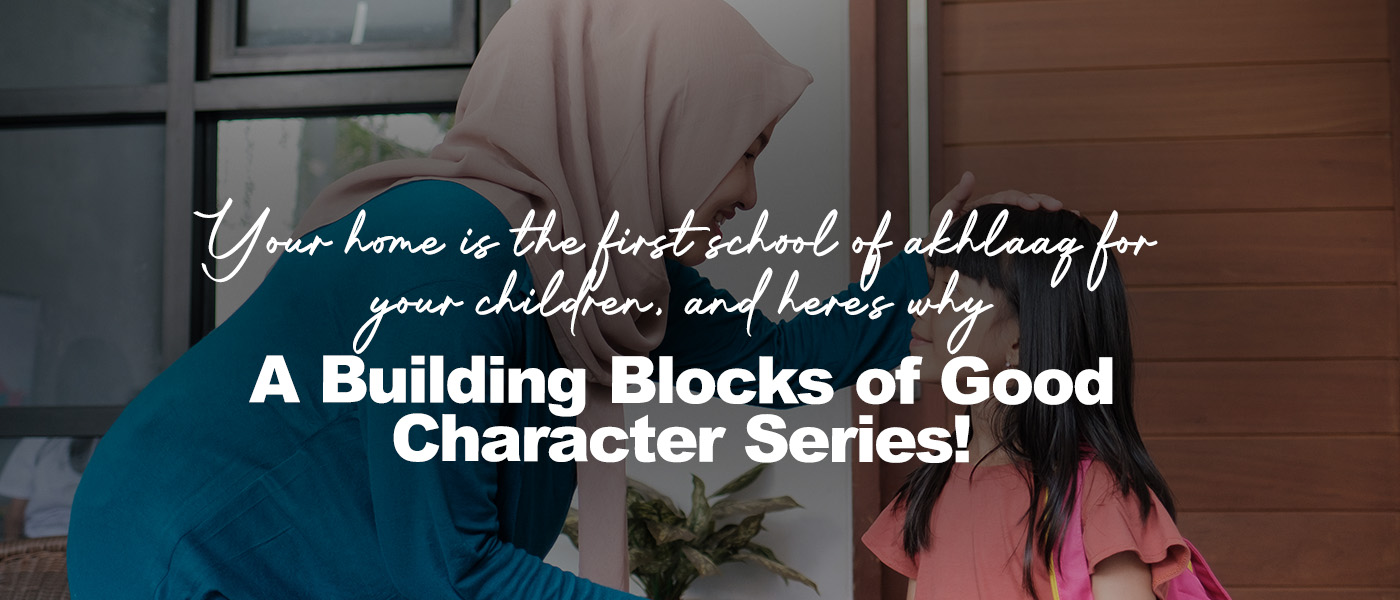
Building Blocks of Good Character is a series focused on the everyday habits that quietly shape a child’s character over time. From prayer and discipline to responsibility, speech, and moral conduct, each article explores how small patterns formed early in life often influence who our children become later on. This series is designed to support parents and educators in recognizing which habits deserve attention early, and how intentional guidance can help raise successful Muslims for the future.
Long before a child enters a classroom, opens a textbook, or memorizes lessons, they begin learning from the environment around them, especially from the home. Family life is the first school of akhlaaq where children quietly absorb the values, manners, emotions, and behaviors that will shape them for years to come. The way parents speak, respond to stress, show affection, handle disagreements, and treat others all become living lessons in character. In Islam, akhlaaq is not viewed as something secondary or optional. Good character is at the heart of faith itself. The Prophet (SAW) said, “The best among you are those who have the best character.” (Sahih Bukhari) For this reason, raising children is not only about providing food, education, or physical care. It is also about cultivating hearts that are truthful, merciful, respectful, patient, and conscious of Allah (SWT). A child may forget many lectures, but they rarely forget the emotional atmosphere of their home. They remember how they were spoken to, how conflicts were resolved, and whether kindness and sincerity were practiced consistently.
Children learn akhlaaq through observation before instruction. A parent who speaks gently teaches gentleness without a formal lesson. A mother or father who apologizes after making a mistake teaches humility and accountability. A family that says “Bismillah!” before eating, thanking one another, helping neighbors, and speaking respectfully about others is constantly teaching character in ways that feel natural and lasting. Allah (SWT) reminds believers in The Quran, “O believers! Protect yourselves and your families from a Fire whose fuel is people and stones, overseen by formidable and severe angels, who never disobey whatever Allah orders—always doing as commanded.” (The Clear Quran®, 66:6)
The scholars explain that part of protecting one’s family is teaching them faith, manners, and righteous conduct. This responsibility goes beyond correcting bad behavior, it includes actively building a home environment where good character can grow. Love, consistency, mercy, discipline, honesty, and emotional safety all play an important role in a child’s moral and spiritual development. The Prophet (SAW) himself was the greatest example of beautiful character within family life. He (SAW) showed mercy to children, listened attentively, expressed affection openly, and treated his family with gentleness and dignity. His home was not built upon harshness or fear, but upon compassion, patience, and wisdom. Through his example, Muslims learn that strong families are not formed merely through authority, but through righteous character lived every day.
In a world where children are influenced by social media, peers, and countless outside voices, the role of the family has become even more important. The home remains the place where values are either strengthened or weakened. When children grow up in a household rooted in Islamic manners and sincere faith, they carry those qualities into their friendships, schools, communities, and future families. Family life, therefore, is far more than a place of care and companionship. It is the foundation upon which a child’s understanding of akhlaaq is built. One conversation, one example, and one daily interaction at a time.
Remember, children learn more from what they see than what they hear
One of the most important realities parents and caregivers must understand is that children are constantly observing. They learn not only from direct instruction, but from the everyday behavior they witness inside the home. A child may not fully understand long lectures about honesty, patience, or kindness, but they can easily recognize whether those qualities are practiced consistently by the people closest to them. This is why example is one of the strongest tools of tarbiyah in Islam. Children naturally imitate the attitudes, speech, and habits of their families. The tone parents use during stressful moments, the way elders are treated, how disagreements are handled, and even how gratitude is expressed all leave deep impressions on young hearts. The Prophet (SAW) was the greatest teacher of character because he (SAW) embodied the values he (SAW) taught. His companions did not only listen to his words, they witnessed his mercy, patience, humility, and sincerity in daily life.
Allah (SWT) says, “Indeed, in the Messenger of Allah you have an excellent example for whoever has hope in Allah and the Last Day, and remembers Allah often.” (The Clear Quran®, 33:21) This principle begins within the family. When parents pray consistently, children begin to understand that salah matters. When they hear their parents speak truthfully, avoid gossip, show generosity, and apologize after mistakes, they learn that good character is not simply spoken about, it is lived. On the other hand, children can also become confused when there is a gap between words and actions. Constantly instructing children to be respectful while speaking harshly to them, or teaching honesty while behaving dishonestly in front of them, weakens the impact of those lessons. Young minds are deeply sensitive to inconsistency.
Even small moments can become powerful lessons in akhlaaq. A father lowering his voice during anger teaches self-control. A mother showing patience during difficulty teaches resilience and trust in Allah (SWT). Siblings helping one another, family members saying “Jazakallahu Khayran” or parents showing kindness to neighbors all contribute to shaping a child’s understanding of how Muslims should behave. This does not mean parents must be perfect. Every family experiences mistakes and moments of weakness. In fact, children can learn valuable lessons when parents admit faults, seek forgiveness, and try to improve themselves. This teaches humility, accountability, and sincerity. All of these are qualities that are essential parts of Islamic character.
A home filled with good examples creates an environment where akhlaaq is absorbed naturally. Over time, these repeated experiences become part of a child’s identity. What they repeatedly see in the home often becomes the character they carry into the world.
The emotional environment of the home shapes character
A child’s character is not formed only through rules and instructions, it is also shaped by the emotional atmosphere they grow up in. The home is where children first learn how to respond to emotions, interact with others, and feel secure in their identity. An environment filled with mercy, respect, and emotional balance helps nurture healthy akhlaaq, while constant anger, criticism, or neglect can leave lasting effects on a child’s behavior and emotional well-being. Islam places great importance on mercy within family life. Allah (SWT) describes the relationship between believers as one built upon compassion, and the Prophet (SAW) consistently demonstrated gentleness in his interactions with children and family members. He (SAW) understood that hearts flourish through mercy, not harshness. The Prophet (SAW) said, “The merciful are shown mercy by the Most Merciful. Show mercy to those on the earth, and the One above the heavens will show mercy to you.” (Sunan at-Tirmidhi)
Children who grow up in emotionally safe homes are more likely to develop confidence, empathy, patience, and emotional stability. When they are listened to respectfully, corrected with wisdom, and treated with affection, they begin to associate Islam and good character with warmth, dignity, and care. This does not mean children are never disciplined, but that discipline is balanced with mercy, fairness, and understanding. Simple daily interactions often have a deep impact. A parent calmly listening to a child’s fears teaches compassion and attentiveness. Encouraging words during failure teach hope and resilience. Showing appreciation for small acts of kindness teaches gratitude. Even the way family members greet one another, share meals, and spend time together contributes to the moral and emotional development of children.
The Prophet (SAW) openly expressed affection toward children, something that was uncommon in parts of Arab society at the time. He (SAW) hugged his grandchildren, carried them during prayer, and spoke gently to young companions. His example reminds Muslim families that love and emotional connection are not weaknesses, they are part of prophetic character. At the same time, the emotional environment of the home also teaches children how to handle conflict. Every family faces disagreements and stressful moments, but children observe whether problems are managed with patience and wisdom or with shouting and disrespect. A home where forgiveness, calm communication, and mutual respect are practiced helps children develop emotional maturity and self-control.
When families intentionally create homes filled with the remembrance of Allah (SWT), gratitude, kindness, and emotional balance, children begin to internalize those values naturally. The home becomes more than just a place to live, it becomes a nurturing space where faith and character grow together.
Daily habits and routines build lasting akhlaaq
Good character is not developed through occasional reminders alone. Akhlaaq is built gradually through small, repeated actions that become part of a child’s daily life. The routines and habits practiced within the home shape how children think, behave, and respond to the world around them. Over time, these ordinary moments become the foundation of lifelong character. Islam beautifully connects worship with daily behavior. Simple acts such as saying “Bismillah” before eating, greeting others with salaam, thanking people, asking permission, speaking kindly, and making dua throughout the day all help children develop awareness of Allah (SWT) and mindfulness in their interactions. These practices may appear small, but their consistent repetition nurtures discipline, humility, gratitude, and respect. The Prophet (SAW) paid close attention to manners in everyday situations and taught that even simple acts carry great value in Islam. He (SAW) said, “Nothing is heavier on the Scale on the Day of Judgment than good character.” (Sunan at-Tirmidhi)
Family routines often become silent lessons in akhlaaq. A child who regularly sees parents parting on time learns the importance of worship and responsibility. Helping set the table teaches cooperation and service. Cleaning up after oneself teaches accountability. Visiting relatives teaches the value of maintaining family ties. Speaking politely at home teaches respect that children later carry into school, friendships, and society. Consistency is especially important. Children thrive when good habits are practiced regularly and reinforced with patience. Character is not built overnight, nor is it formed through fear or constant criticism. Rather, it grows through gentle repetition, encouragement, and positive examples. A home where kindness, honesty, and respect are practiced daily helps those values become natural to a child.
Even family traditions can play a role in strengthening akhlaaq. Reading The Quran together, sharing reflections after salaah, eating meals as a family, giving charity together, or discussing stories of the prophets all create meaningful opportunities for moral and spiritual growth. These moments strengthen both family bonds and Islamic identity. At the same time, children also learn from how families handle ordinary responsibilities and challenges. When parents show patience during hardship, avoid foul language during frustration, or remain fair during disagreements, children witness practical examples of Islamic manners in real life. These experiences teach that akhlaaq is not limited to religious gatherings or formal lessons, it is meant to appear in everyday conduct.
Over the years, these daily habits shape a child’s instincts and character. What begins as guided behavior slowly becomes part of who they are. This is why the routines established inside the home are so powerful, they quietly prepare children to carry good character into every stage of life.
How Furqaan Academy Bolingbrook encourages good akhlaaq
At Furqaan Academy Bolingbrook, akhlaaq is viewed as an essential part of a child’s Islamic identity and overall judgment. Alongside academic excellence, the school strives to nurture students who reflect Islamic manners, compassion, responsibility, and respect in their daily lives. Good character is not treated as a separate lesson, but as something woven into the culture of the school environment. The Prophet (SAW) said, “The believers with the most complete faith are those with the best character.” (Sunan at-Tirmidhi) With this understanding, students are encouraged to practice Islamic manners consistently both inside and outside the classroom. Some of the ways akhlaaq is reinforced at Furqaan Academy Bolingbrook include:
- Encouraging respectful speech and behavior with teachers, classmates, and staff.
- Teaching Islamic manners through daily practices, not only through textbooks or lectures.
- Promoting honesty, responsibility, and accountability in school and interactions.
- Creating a caring and emotionally supportive environment where students feel valued and respected.
- Using prophetic examples and Islamic teachings to help students understand the importance of good character.
- Encouraging kindness, cooperation, and empathy among peers.
- Reinforcing habits of worship and remembrance of Allah (SWT) throughout the school day. Partnering with parents to help maintain consistency between home and school values.
- Modeling good character through teachers and staff, recognizing that children learn greatly through observation.
When children regularly experience these values at both home and school, the lessons of akhlaaq become more meaningful and lasting. Consistency between parents, teachers, and the wider community helps create an environment where children can grow spiritually, emotionally, and socially with confidence and strong Islamic character.
Raising children with beautiful Islamic character
The foundation of a child’s character begins long before adulthood. It is built slowly through conversations at the dinner table, the tone of a parent’s voice, acts of kindness between family members, daily worship, and the countless small interactions that shape life inside the home. Family life truly becomes the first school of akhlaaq where children learn not only what Islam teaches, but how those teachings are lived. In Islam, good character is not limited to outward manners alone. It reflects the condition of the heart, one’s relationship with Allah (SWT), and the way a person treats others. This is why nurturing akhlaaq within the family is one of the greatest responsibilities and blessings entrusted to parents and caregivers. Every moment of patience, mercy, honesty, and compassion becomes part of a child’s moral and spiritual foundation. At the same time, parents do not carry this responsibility alone. Schools and communities that value Islamic manners and character, such as Furqaan Academy Bolingbrook, help reinforce the lessons children receive at home. When families and educators work together with sincerity and consistency, children are more likely to grow into individuals who carry faith, respect, and beautiful manners into every area of life.
The Prophet (SAW) said, “I was only sent to perfect good character.” (Musnad Ahmad)
This powerful statement reminds us that akhlaaq is at the heart of Islam itself. Raising children with good character is not simply about preparing them for success in this world, but about nurturing hearts that seek the pleasure of Allah (SWT) and positively impact those around them. Every home has the ability to become a place where mercy is practiced, faith is strengthened, and beautiful character is cultivated day by day. Even small efforts, when done consistently and sincerely, can leave a lasting impact on a child for the rest of their lives.
Dua
O’ Allah (SWT)! Fill our homes with faith, mercy, tranquility, and beautiful character. Make The Quran a light within our hearts and within our homes. O’ Allah (SWT)! Bless our children with honesty, good manners, modesty, and compassion, and plant within their hearts love for You and love for Your Messenger (SAW).
O’ Allah (SWT)! Make us righteous role models for them, and help us raise them upon Islam, faith, and beautiful character. O’ Allah (SWT)! Protect our families from trials and temptations. Make our children among the people of righteousness and God-consciousness, and make them a a source of goodness in this life and the Hereafter.
Ameen, ya Rabb!