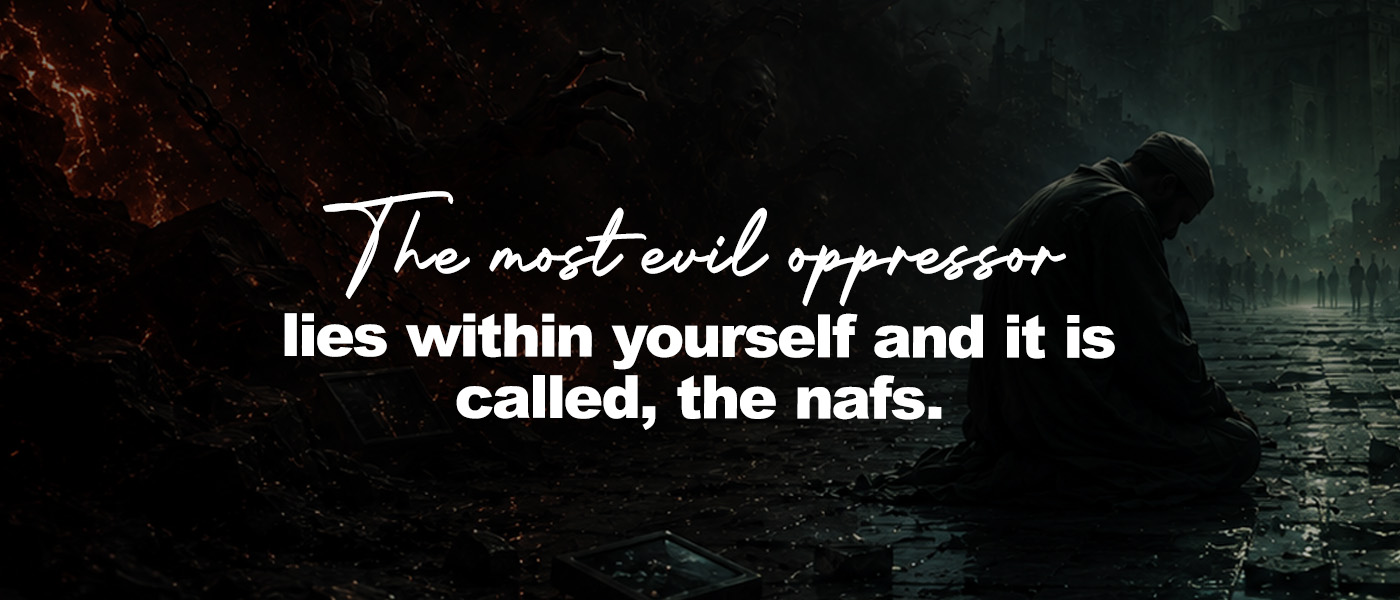
The invisible battlefield within
Among the most profound ideas in Islam is the understanding that the greatest struggles faced by human beings are often invisible. Beneath outward actions, public identities, and worldly ambitions lies an internal battlefield that every person must confront throughout life. Islam identifies this struggle as Jihad al-Nafs: the striving against the lower self. It is the conflict between revelation and desire, between conscience and impulse, between the soul that seeks closeness to Allah (SWT), and the ego that seeks control, indulgence, validation, and comfort. Although modern discussions often reduce the word jihad to armed conflict, the Islamic intellectual and spiritual tradition has long recognized that one of the most difficult forms of striving is the discipline of the self and the purification of the heart. This is not a temporary struggle that emerges only during moments of crisis. Rather, it is a lifelong process that shapes every intention, decision, and moral choice a believer makes.
Quranic portrait of the human soul
The Quran presents the human soul with remarkable psychological depth. It neither portrays humanity as inherently angelic nor condemns mankind as irredeemably corrupt. Instead, it describes the soul as possessing conflicting inclinations—the capacity for immense righteousness alongside the potential for profound moral failure.
Allah (SWT) says, “And by the soul and ˹the One˺ Who fashioned it, then with ˹the knowledge of˺ right and wrong inspired it! Successful indeed is the one who purifies their soul, and doomed is the one who corrupts it!” (The Clear Quran®, 91:7–10).
These verses establish an entire philosophy of human nature within only a few lines. The soul contains both an awareness of truth and an attraction toward temptation. Human beings are capable of sincerity, mercy, discipline, sacrifice, and devotion, yet they are equally vulnerable to arrogance, greed, anger, envy, lust, heedlessness, and self-deception. The defining question of a person’s life, therefore, is not whether they possess weakness, but whether they struggle against it or surrender to it. Islam teaches us that spiritual success is inseparable from tazkiyat al-nafs—the purification of the soul. The corruption of the inner self eventually manifests outwardly in behavior, relationships, and even society itself. Long before oppression appears publicly, it begins privately within hearts consumed by ego, unchecked desire, and moral compromise. For this reason, the Quran repeatedly calls believers toward self-awareness, reflection, and accountability.
Allah (SWT) says in Surah Yusuf, “And I do not seek to free myself from blame, for indeed the soul is ever inclined to evil, except those shown mercy by my Lord. Surely my Lord is All-Forgiving, Most Merciful.” (The Clear Quran®, 12:53).
How the nafs deceives: The psychology of self‑justification
The above verse captures a reality recognized by both spirituality and psychology: human beings possess an extraordinary ability to rationalize their own behavior. The nafs rarely presents wrongdoing openly. Instead, it beautifies temptation, minimizes sin, justifies excess, and shields the ego from accountability. Pride disguises itself as confidence, envy as ambition, anger as strength, and vanity as self-respect. Even acts of worship can become corrupted when sincerity is replaced by the desire for praise or recognition.
In this sense, Jihad al-Nafs is not merely the struggle against obvious immorality. It is also the confrontation with subtle psychological distortions that gradually distance the heart from Allah (SWT) while convincing a person they remain spiritually secure. Islam does not separate spiritual purification from ordinary life. Jihad al-Nafs unfolds continuously within everyday experiences: restraining anger during conflict, lowering the gaze when confronted with temptation, remaining honest when dishonesty would be profitable, resisting arrogance after success, and choosing patience when the ego demands immediate gratification. Every moment becomes an opportunity either to strengthen the discipline of the soul or to weaken it. The believer is therefore engaged in a constant struggle between immediate desire and eternal accountability.
Islam and modern psychology: A converging understanding
What is especially striking is how deeply these Islamic concepts intersect with modern psychological understanding. Contemporary psychology explores self-control, emotional regulation, addiction, trauma, cognitive dissonance, and identity formation. Islam addresses many of these same realities, but frames them within a spiritual worldview rooted in accountability before Allah (SWT).
The Quran recognizes the instability of human emotion, the influence of the environment, the dangers of unchecked desire, and the transformative power of habits long before these subjects became formal fields of psychological study. Yet Islam goes beyond merely analyzing human behavior. It asks deeper questions: What purifies the human being? What corrupts the heart? Why do people knowingly act against their own values? What creates true tranquility? And ultimately, what enables a person to overcome the tyranny of the ego and live in sincere submission to their Creator? Classical Muslim scholars often described the heart as a kingdom under siege. The intellect, revelation, and conscience call the believer toward obedience, humility, and remembrance of Allah (SWT), while the nafs, worldly distractions, and the whispers of Shaytan draw the soul toward heedlessness and excess. Every action nourishes one side of this struggle. Repeated sins darken the heart and weaken spiritual sensitivity, whereas acts of worship strengthen moral awareness, discipline, and sincerity. Over time, the soul becomes shaped by whatever it consistently pursues.
For this reason, Islam places profound emphasis on acts of worship such as prayer, fasting, dhikr, charity, repentance, and recitation of the Quran. These are not empty rituals; they are forms of spiritual training designed to weaken the dominance of the ego and cultivate mastery over the self.
Exemplars of inner mastery in early Islam
Throughout Islamic history, there are several examples of moral steadfastness that demonstrate extraordinary mastery over the nafs in different ways. The caliphs of Islam each embodied a unique dimension of this struggle: Abu Bakr as-Siddiq (ra) resisted attachment and self‑preservation through quiet generosity and unwavering trust in Allah; Umar ibn al-Khattab (ra) battled pride and the temptations of authority by welcoming correction and humbling himself before the vulnerable; Uthman ibn Affan (ra) conquered vanity and desire for recognition through modesty and private charity; and Ali ibn abi Talib (ra) restrained anger and ego even in moments of intense conflict, acting from principle rather than impulse.
Beyond the caliphs, other companions, men and women alike, also demonstrated profound inner discipline. Abu Dharr (ra) overcame the nafs of materialism and status through ascetic simplicity, Bilal ibn Rabah (ra) triumphed over fear and physical torment with steadfast faith, and Salman al‑Farisi (ra) transcended cultural pride and identity in his search for truth. Among the women, Umm Sulaym of the Ansar (ra) displayed extraordinary emotional restraint and patience, Lady Asma bint Abu Bakr (ra) overcame fear and hardship during the Hijrah, Lady Khadījah bint Khuwaylid (ra) sacrificed wealth and comfort for Allah’s (SWT) sake, and Lady Fatima bint Muhammad (ra) embraced humility and endurance in a life of hardship. Within this broader prophetic legacy, Hussain ibn Ali (ra) stands as the paradigm of excellence when combatting against his nafs during immense hardship. At Karbala, he chose principle over worldly gain, embodying the essence of Jihad al‑Nafs by remaining steadfast when the ego might urge fear, compromise, or silence.
Together, these lives show that the struggle against the nafs is universal, cutting across gender, status, temperament, and circumstance, and that true mastery begins within the self long before it manifests outwardly in the world.
While most believers will never face trials of such magnitude, every person encounters moments in which the ego urges compromise, silence in the face of wrongdoing, arrogance, revenge, or submission to worldly desires. The spiritual lesson is universal: the believer must constantly decide whether they will be governed by temporary desires or eternal truths.
This article explores Jihad al-Nafs as both a spiritual and psychological struggle. It examines the Islamic understanding of the soul, the stages of the nafs, the mechanisms of temptation, the role of worship in self-transformation, and the ways modern psychological insights intersect with Quranic teachings on human nature. Before a person can reform society, resist injustice, or seek closeness to Allah (SWT) outwardly, they must first confront the battlefield within themselves, the place where every act of sincerity, discipline, corruption, and transformation truly begins.
Self-control across faith traditions: Humanity’s universal inner struggle
Long before psychology emerged as a formal science, civilizations recognized that one of the defining challenges of human existence was the struggle to govern the self. Across religions, philosophies, and spiritual traditions, there exists a remarkably consistent understanding that human beings possess conflicting impulses (noble aspirations on one side and destructive desires on the other). Whether described as temptation, ego, attachment, sin, passion, or the lower self, nearly every major tradition acknowledges that unchecked desire can corrupt both the individual and society. The language differs, the theology differs, and the methods differ, but the central insight remains universal such as, a person who cannot control themselves eventually becomes controlled by their impulses.
This universality reveals something fundamental about human nature itself. Self-control is not merely a religious demand imposed upon humanity, it is woven into the human condition. Every person experiences the tension between immediate gratification and long-term well-being, between emotional impulse and rational restraint, between what feels pleasurable and what is morally right. Ancient societies observed that civilizations often collapsed not only because of external enemies, but because of internal moral decay such as greed overcoming justice, lust overcoming discipline, pride overcoming humility, and anger overcoming wisdom. At the personal level, individuals suffer in similar ways. Addiction, destructive relationships, impulsive behavior, uncontrolled anger, envy, and obsession all emerge from the inability to regulate the self. A series of experiments conducted for a study, Religion replenishes self-control, by the Association for Psychological Science (APS), experts found that “when religious themes were made implicitly salient, people exercised greater self-control, which, in turn, augmented their ability to make decisions in a number of behavioral domains that are theoretically relevant to both major religions and humans’ evolutionary success.” Further, when people had no self-control resources, “implicit reminders of religious concepts refueled people’s ability to exercise self-control.” Throughout this study and experimentation, even those who were “moderately religious” found themselves “[carrying their] religious or spiritual beliefs over into [their] other dealings in life.”
In Christianity, self-control occupies a central place within spiritual life. The New Testament repeatedly emphasizes mastery over worldly desires and the purification of the heart. In the Epistle to the Galatians, self-control is listed among the “fruits of the Spirit,” alongside virtues such as patience, kindness, and faithfulness. Christian monastic traditions especially viewed human beings as engaged in a constant struggle against passions that cloud spiritual clarity and distance the soul from God. Early Christian ascetics often retreated into isolation not because they despised the world itself, but because they recognized how easily the ego becomes enslaved by comfort, vanity, and indulgence. The goal was not mere repression, but transformation through discipline, humility, sincerity, and devotion.
Similarly, in Judaism, mastery over one’s inclinations is deeply embedded within religious ethics. Rabbinic literature frequently discusses the conflict between the yetzer hara, the inclination toward selfish or sinful behavior, and the yetzer hatov, the inclination toward goodness and obedience to God. Human beings are not viewed as inherently evil, but as morally responsible creatures navigating competing internal drives. Discipline, reflection, repentance, and adherence to divine law become means through which a person aligns their desires with righteousness rather than impulse.
In Eastern traditions such as Buddhism and Hinduism, self-mastery also occupies a central role, though approached through different metaphysical frameworks. Buddhism, for example, identifies craving and attachment as primary sources of suffering. The undisciplined mind continuously pursues pleasure, avoids discomfort, and clings to illusions of permanence, trapping the individual in cycles of dissatisfaction and emotional instability. Spiritual practice therefore involves training the mind through mindfulness, detachment, ethical conduct, and meditation. Hindu traditions similarly emphasize control over desires and senses as necessary for spiritual elevation and liberation from lower states of existence. Across these traditions, the ego is often viewed as a source of illusion that obstructs inner peace and wisdom.
What is remarkable is that despite major theological differences, these traditions converge on a shared psychological truth: human beings possess appetites that, if left unchecked, can dominate perception, behavior, and identity. Modern psychology increasingly supports this understanding. Research on impulse control, delayed gratification, emotional regulation, and habit formation demonstrates that self-discipline is closely tied to long-term well-being, mental stability, healthy relationships, and even physical health. Studies repeatedly show that individuals capable of regulating their impulses tend to make wiser decisions, maintain healthier lifestyles, and navigate adversity more effectively. In contrast, impulsivity is strongly associated with addiction, aggression, anxiety, self-destructive behavior, and social dysfunction.
Yet modern society often treats self-control with suspicion or discomfort. Contemporary culture often encourages the unrestricted pursuit of desire under the banner of authenticity or personal freedom. Consumption is celebrated, restraint is viewed as repression, and discipline is often framed as unnecessary limitation. Social media, entertainment industries, advertising, and digital algorithms are designed to stimulate impulse continuously such as training individuals toward distraction, instant gratification, emotional reactivity, and constant validation-seeking. In many ways, modern environments weaken the human capacity for patience and reflection by rewarding immediacy and excess.
Islam as the pinnacle teacher of self-control
In the Religion Replenishes Self-Control study, researchers proposed that religion functions as an organized cultural belief system that strengthens self-control, thereby encouraging behaviors beneficial to the stability of large-scale societies. The study provided some of the first causal evidence for this claim, finding that individuals exercised greater self-control when religious themes were implicitly activated than when they were absent. Religious reminders also increased people’s willingness to endure difficult situations and heightened awareness of their moral and social reputation. Islam enters this discussion with a particularly balanced understanding of human nature.
Unlike traditions that portray the body or desire itself as inherently evil, Islam recognizes natural desires as part of Allah’s (SWT) creation while insisting they remain governed by revelation and moral discipline. Hunger is not evil, but gluttony is destructive. Sexual desire is not condemned, but its misuse corrupts individuals and societies. Ambition is not forbidden, yet arrogance and obsession with status poison the heart. Anger itself is not sinful, but uncontrolled anger becomes a gateway to injustice and regret. Islam therefore does not seek to eliminate human emotion or desire; rather, it seeks to order them beneath obedience to Allah (SWT). This distinction is essential to understanding Jihad al-Nafs. The struggle against the self is not a war against human nature itself, but an effort to prevent the ego from becoming sovereign over the soul. In Islamic thought, the purified believer is not someone devoid of emotion or desire, but someone whose desires have been disciplined and aligned with divine guidance. The goal is balance rather than the annihilation of the self.
Prophet Muhammad (SAW) consistently emphasized this principle throughout his teachings. He praised restraint not as weakness, but as a sign of true strength. In an authentic hadith, he said, “The strong man is not the one who can overpower others in wrestling, but the strong man is the one who controls himself when angry.” (Sahih Bukhari). This statement fundamentally reframes the meaning of power. Societies often define strength through dominance, aggression, physical ability, wealth, or status. Islam redirects attention inward. A person who conquers others but remains enslaved to rage, arrogance, greed, lust, or pride has not truly mastered themselves. Real strength lies in internal governance—the ability to restrain the ego when it demands excess, retaliation, or self-glorification.
This understanding transforms Jihad al-Nafs into far more than a private spiritual exercise. It becomes the foundation of ethical living, emotional maturity, and social harmony. Families collapse when anger and selfishness go unchecked. Communities decay when greed and envy dominate hearts. Entire civilizations suffer when collective desires become detached from moral accountability. The inner condition of human beings inevitably shapes the outer condition of societies. For this reason, Islam treats self-control not as an optional spiritual luxury reserved for the exceptionally religious, but as a necessary component of faith itself. Every act of worship trains the believer toward discipline. Prayer interrupts heedlessness. Fasting weakens impulsive desires. Charity restrains greed. Repentance softens arrogance. Remembrance of Allah (SWT) interrupts distraction. Even silence, patience, and lowering the gaze become forms of spiritual resistance against the ego’s constant demands.
The nafs in Islam: Self-control, mental health, and the inner self
One of the defining features of modern life is internal fragmentation. People today are more connected than any previous generation, yet many feel profoundly disconnected from themselves. The modern individual is often pulled in countless directions by social expectations, digital identities, career pressures, political anxieties, consumer culture, emotional trauma, and the constant pressure to publicly perform happiness while privately struggling to maintain stability. As a result, many people no longer experience the self as unified, but as divided. A person may intellectually value discipline while emotionally craving escapism. They may publicly advocate morality while privately battling addiction, resentment, or loneliness. They may appear confident outwardly while internally consumed by insecurity and comparison. In many cases, modern psychological distress is not merely sadness or anxiety, but the exhausting experience of contradiction which is the tension of living between competing desires, identities, and realities. Islam recognized this internal instability long before modern psychology developed language for it. The Quran frequently describes the human being as forgetful, reactive, impatient, emotionally vulnerable, and easily overwhelmed by desire or fear.
Allah (SWT) says, “Indeed, humankind was created impatient: distressed when touched with evil, and withholding when touched with good—” (The Clear Quran®, 70:19–21).
This is where the concept of the nafs becomes psychologically profound. The nafs is not simply a source of temptation, it is the unstable center of the human personality that constantly reacts to external stimulation. Without spiritual grounding, the self becomes controlled by circumstances. Success produces arrogance, failure produces despair, praise produces vanity, criticism produces anger, pleasure produces attachment, and loss produces emotional collapse. In other words, the undisciplined self lacks internal authority. Modern psychology discusses emotional regulation, impulse control, identity formation, and cognitive conditioning. Islam approaches these realities through spiritual language, yet reaches many of the same conclusions that a person who never learns to govern their inner world eventually becomes governed by it.
This helps explain why modern society experiences such widespread exhaustion despite unprecedented comfort. Human beings were not designed to exist in a constant state of stimulation. Social media trains comparison, advertising cultivates dissatisfaction, consumer culture encourages endless craving, and digital life fragments attention while weakening stillness. The modern individual is continuously encouraged to satisfy every appetite immediately whether it’s emotional, sexual, financial, psychological, and social. Yet the more the self is indulged, the less satisfied it often becomes. Islamic spirituality identifies this as one of the great deceptions of the nafs, and that is the belief that unrestricted desire leads to freedom. In psychology, this concept is famously known as “hedonic adaptation.” According to the study, Hedonic Adaptation to Positive and Negative Experiences, the model displayed two different paths as a result of adaptation. The author highlights, “the first path specifies that the steam of positive or negative emotions resulting from the life change may lessen over time, reverting people’s happiness levels back to their baseline.” The second path concludes that due to certain events and their subsequent expectations, “the individual now takes for granted circumstances that used to produce happiness or is inured to circumstances that used to produce happiness.”
In reality, unchecked desire often produces dependency. A person who cannot control anger becomes controlled by anger. A person who cannot control desire becomes controlled by desire. A person obsessed with validation becomes emotionally imprisoned by the opinions of others. For this reason, Islam places enormous emphasis on internal discipline—not to suppress human nature, but to liberate it from enslavement to impulse.
The Prophet Muhammad (SAW) hinted at this psychological reality in a powerful supplication, “O Allah, do not leave me to myself even for the blink of an eye.” (Musnad Ahmad)
This understanding becomes increasingly important when discussing mental health in the modern world. Islam does not teach that every emotional struggle results from spiritual weakness. Trauma, clinical depression, anxiety disorders, and psychological illnesses are real and should never be trivialized. However, Islam also recognizes a reality that modern culture often overlooks. However, a soul disconnected from meaning, discipline, and remembrance of Allah (SWT) eventually becomes vulnerable to a form of emptiness that material success cannot cure. The crisis of the modern self is therefore not merely emotional, but existential. People know more, consume more, and possess more than many civilizations before them, yet many remain internally restless because the soul itself has not been nourished. The nafs continues demanding more stimulation while the heart quietly searches for peace. This is the paradox at the center of Jihad al-Nafs. The person seeking mastery over the world must first learn mastery over themselves.
The lifelong struggle for mastery of the soul
Ultimately, Jihad al-Nafs is the lifelong struggle to bring the self into harmony with what Allah (SWT) has revealed, resisting the chaos of unchecked desire, ego, and distraction in pursuit of spiritual clarity and inner stability. In an age defined by overstimulation, emotional exhaustion, and constant pressure to indulge every impulse, Islam offers a radically different version of human freedom. True peace is not found in obeying every desire, but in disciplining the soul so that desires no longer control the heart. The Quran and Sunnah present this struggle not as a denial of human nature, but as its refinement, a process through which anger becomes restraint, guilt becomes repentance, suffering becomes patience, and worship becomes transformation.
From the examples of the prophets and righteous believers to the ordinary internal battles faced by every Muslim today, Jihad al-Nafs remains one of the most difficult realities of all—the battle between who they are, who they wish to become, and who Allah (SWT) calls them to be.
Dua
اللَّهُمَّ آتِ نَفْسِي تَقْوَاهَا، وَزَكِّهَا أَنْتَ خَيْرُ مَنْ زَكَّاهَا، أَنْتَ وَلِيُّهَا وَمَوْلَاهَا
“O Allah! Grant my soul its righteousness and purify it, for You are the best to purify it. You are its Protector and Master.”
(Sahih Bukhari)