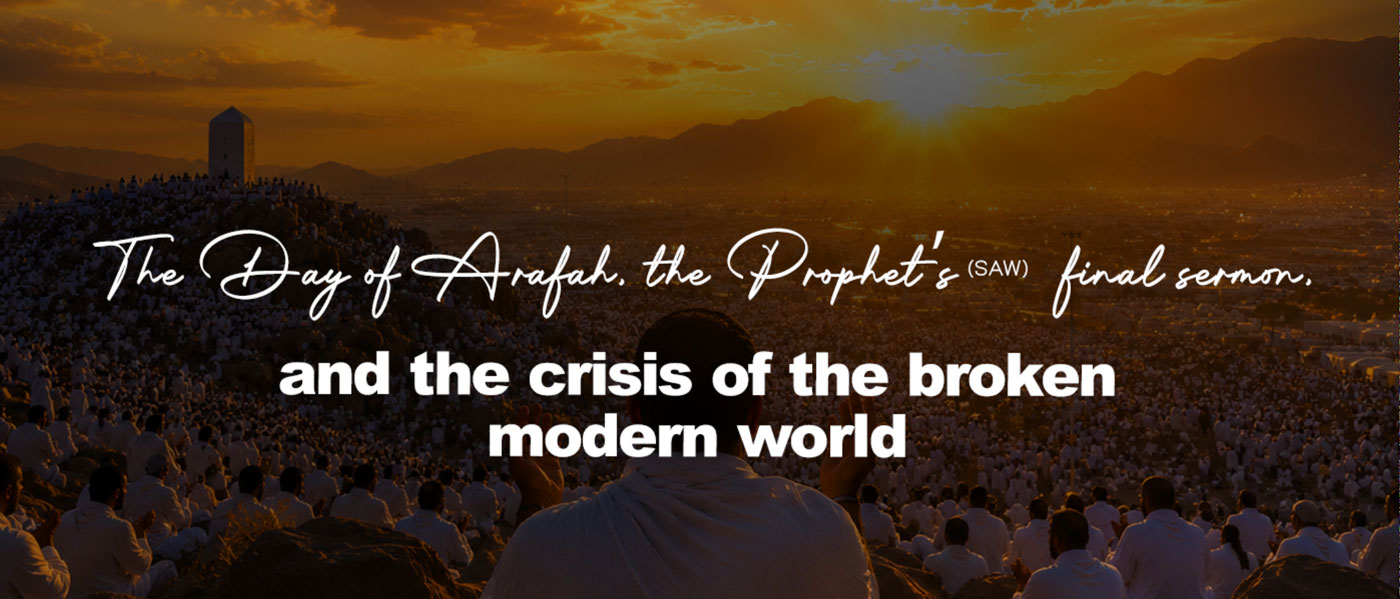
In the final year of his life, during the sacred days of Hajj in the blessed month of Dhul Hijjah, the Prophet Muhammad (SAW) stood before a vast gathering of believers on the plain of ‘Arafah and delivered what would become one of the most important speeches in human history: the Farewell Sermon.
Timeless Lessons from the Farewell Sermon: A blueprint for a just and God‑conscious life
To ground ourselves before exploring the full depth of the Farewell Sermon, below is a concise, consumable roadmap of its most essential teachings – each expounded upon as you read on:
Core Teaching | Quranic Anchor | Timeless Lesson for Today |
Sanctity of Life | “Indeed, We have dignified the children of Adam…” (The Clear Quran® 17:70) | Every soul has sacred worth—reject violence, humiliation, and harm in all forms. |
End of Racism & Tribal Superiority | “The most noble of you… is the most righteous.” (The Clear Quran® 49:13) | No identity elevates one person over another—only taqwa does. Stand against racism and arrogance. |
Economic Justice & No Exploitation | “Beware of a war with Allah and His Messenger!” (The Clear Quran® 2:278–279) | Build ethical financial habits—avoid exploitation, honor workers, and give generously. |
Rights & Dignity of Women | “Treat them fairly.” (The Clear Quran® 4:19) | Women are a trust from Allah (SWT)—uphold justice, compassion, and respect in all relationships. |
Unity of the Ummah | “The believers are but one brotherhood…” (The Clear Quran® 49:10) | Heal division, reject factionalism, and build sincere bonds rooted in faith and justice. |
Accountability Before Allah (SWT) | “Indeed, Allah commands justice, grace…” (The Clear Quran® 16:19) | Live with God‑consciousness—your actions matter even when unseen. |
Holding Firmly to Revelation | “Today I have perfected your faith…” (The Clear Quran® 5:3) | Let The Quran and Sunnah guide decisions, values, and moral clarity. |
Justice as a Social Foundation | “He forbids indecency, wickedness, and aggression.” (The Clear Quran® 16:19) | Stand against oppression—justice is not optional; it is the backbone of a healthy society. |
Universal Human Dignity | “We have dignified the children of Adam…” (The Clear Quran® 17:70) | Protect honor—avoid backbiting, slander, and public shaming. |
Return to Allah (SWT) | “Be mindful of Allah so you may be shown mercy.” (The Clear Quran® 49:10) | Real reform begins with the heart—seek sincerity, humility, and repentance. |
The Farewell Sermon delivered by the Prophet (SAW) was not a series of casual parting words that one says before they pass, nor are they words that we as Muslims should take lightly, especially in this era. The words of the Prophet (SAW) in this particular sermon were deliberate, weighty, and deeply urgent. The Prophet (SAW) understood that his mission was nearing completion, so he (SAW) addressed the foundations of human society itself – including the sanctity of life, justice, equality, family, economic ethics, accountability before Allah (SWT), and the rights that people hold upon one another. In a world long divided by tribalism, oppression, revenge, and social corruption, he (SAW) presented a framework capable of restoring dignity to humanity.
More than 14 centuries later, the world remains overwhelmed by many of the same crises. We live in an age where human life is often reduced to statistics, where wealth and power determine whose suffering matters, and where division is constantly fueled through race, nationalism, politics, and class. Technological advancement has connected the world physically yet, spiritually and morally, humanity appears more fractured than ever. Anxiety is widespread, injustice is normalized, and truth itself is increasingly manipulated to serve power and desire. It is precisely in such a climate that the Farewell Sermon demands to be revisited.
What makes this sermon extraordinary is not simply its historical significance, but its timeless relevance. The Prophet (SAW) did not speak only to the companions gathered before him, he (SAW) spoke to every generation that would come after them. His words were universal in both scope and purpose. They addressed the human condition at its core, reminding people that no society can survive when greed overcomes justice, when arrogance replaces humility, and when human beings forget their accountability before their Creator.
Allah (SWT) says in The Quran, “Indeed, Allah commands justice, grace, as well as generosity to close relatives. He forbids indecency, wickedness, and aggression. He instructs you so perhaps you will be mindful.” (The Clear Quran®, 16:19) The Farewell Sermon was, in many ways, a practical embodiment of these Quranic principles. It was a declaration that Islam came not only to reform individual spirituality, but to establish justice, mercy, accountability, and moral balance within society. To study this sermon today is not merely an academic exercise or a historical reflection. It is an opportunity to measure the condition of our world against the guidance of revelation. It is a reminder that many of humanity’s modern crises are not new problems, but old diseases appearing in new forms.
In this article, we will explore the central themes of the Farewell Sermon and reflect on how its message continues to speak powerfully to the world we live in today – a world still searching for justice, still struggling with division, and desperately in need of moral clarity.
The setting of the Farewell Sermon: A moment that changed history
To truly appreciate the depth of the Farewell Sermon, it is important to first understand the moment in which it was delivered. In the 10th year after the Hijrah, Prophet Muhammad (SAW) journeyed from Madinah to Makkah to perform what would become his first and only complete Hajj after the migration. Tens of thousands of companions accompanied him, eager to learn the rites of pilgrimage directly from the Messenger of Allah (SAW). However, beyond teaching the rituals of Hajj, the Prophet (SAW) was preparing the Ummah for something far greater – life after his departure from this dunya. By this stage, Islam had transformed Arabia. The tribal conflicts that once consumed the religion had largely come to an end. Idolatry was collapsing. Former enemies stood shoulder-to-shoulder in prayer as brothers in faith. Yet the Prophet (SAW) understood a reality that history repeatedly confirms: societies can outwardly change while still remaining vulnerable to moral decline from within.
It was on the plains of ‘Arafah, during the sacred pilgrimage, that the Prophet (SAW) addressed the people in a sermon that carried the tone of finality. He (SAW) reminded them repeatedly to listen carefully, saying, “Perhaps I may not meet you again after this year.” (Sahih Muslim) These words settled heavily upon the companions. They realized they were not merely hearing advice, they were receiving a final trust from the Messenger of Allah (SAW).
The location itself was deeply significant. ‘Arafah is the heart of Hajj, a place of humility, repentance, equality, and return to Allah (SWT). Rich and poor, Arab and non-Arab, leader and laborer all stood dressed in simple garments, stripped of worldly status and distinctions. In that setting, the Prophet (SAW) delivered a message that emphasized the equality and sacredness of all human beings before their Creator. Among the remarkable aspects of the Farewell Sermon is its balance between spiritual guidance and social reform. The Prophet (SAW) did not isolate worship from ethics, nor faith from human responsibility. He (SAW) spoke about worshipping Allah (SWT), but also about protecting people from oppression. He (SAW) spoke about accountability in the Hereafter, but also about economic exploitation, family rights, and social justice in this world.
This balance is something modern society often struggles to maintain. Today, religion is frequently reduced either to private spirituality disconnected from social responsibility, or to outward identity without inner transformation. The Farewell Sermon rejects both extremes. It presents Islam as a complete way of life, one that reforms the heart while also reforming human conduct. There is also something profoundly moving about the timing of this sermon. Nearing the end of his mission, the Prophet (SAW) did not focus on political dominance, personal legacy, or worldly achievements. Instead, he focused on principles. He reminded people of the sanctity of life, the dangers of injustice, the rights of women, the evil of racism, and the necessity of holding firmly to the Quran and Sunnah.
In a world obsessed with power and image, this alone is a lesson worth reflecting upon. Shortly after the Farewell Sermon, Allah (SWT) revealed, “Today I have perfected your faith for you, completed My favour upon you, and chosen Islam as your way.” (The Clear Quran®, 5:3) This verse marked the completion of the Prophet’s (SAW) mission. The Farewell Sermon, therefore, stands not merely as advice, but as part of the final prophetic guidance given to humanity. Perhaps one of the greatest tragedies today is that, while the sermon is often quoted ceremonially, its principles are rarely lived with sincerity. The modern world continues to suffer from the very injustices the Prophet (SAW) warned against – oppression, division, greed, racism, exploitation, and moral heedlessness.
The sanctity of human life: A principle the modern world continues to violate
Among the first and most powerful themes emphasized in the Farewell Sermon is the sacredness of human life, wealth, and honor. The Prophet Muhammad (SAW) declared before the gathered companions, “Indeed, your blood, your wealth, and your honor are sacred to one another, just as this day of yours is sacred, in this month of yours, in this city of yours.” (Sahih Bukhari) The comparison was profound. The Prophet (SAW) connected the sanctity of human beings to the sanctity of Makkah, Dhul Hijjah, and the Day of ‘Arafah, all of which were deeply revered by the Arabs and held sacred in Islam. In doing so, he (SAW) established a principle that remains revolutionary even today. Human life is not cheap in the sight of Allah (SWT). This message stands in stark contrast to the condition of the modern world.
Every day, people witness scenes of war, displacement, oppression, and violence unfolding across the globe. Innocent lives are lost so frequently that entire tragedies are reduced to headlines and statistics. In many cases, the value of human life appears to depend on geography, ethnicity, political interest, or economic influence. Some deaths provoke global outrage, while others are met with silence. The Farewell Sermon directly challenges this moral inconsistency. Islam teaches that every human soul possesses dignity granted by Allah (SWT) Himself.
Allah (SWT) revealed in The Quran, “Indeed, We have dignified the children of Adam, carried them on land and sea, granted them good and lawful provisions, and privileged them far above many of Our creatures.” (The Clear Quran®, 17:70) Notice that Allah (SWT) did not limit this honor to a specific race, nationality, or class of people. Human dignity is inherent because it comes from the Creator. The Prophet (SAW) reinforced this principle throughout his life. He (SAW) condemned murder, injustice, abuse, and oppression in all forms. He (SAW) warned that oppression would become darkness on the Day of Judgment. He (SAW) taught that even harming another person through insult, humiliation, or violation of their rights was a serious matter before Allah (SWT). Yet today, despite international laws, human rights organizations, and global institutions, humanity continues to struggle with the very basics of justice and compassion.
Violence has become easier to witness and easier to ignore. Social media exposes suffering instantly, but constant exposure has also desensitized many hearts. Outrage is often temporary, sympathy is selective, and moral consistency is increasingly rare. The Farewell Sermon reminds believers that sacredness does not change based on convenience. A Muslim is not allowed to violate the dignity of another person simply because of disagreement, anger, politics, race, or power. Backbiting, slander, exploitation, abuse, and injustice all fall under violations of the honor the Prophet (SAW) declared sacred. The Farewell Sermon, therefore, calls not only for the protection of life in the physical sense, but also for the protection of human dignity itself.
This message is especially important in an era wherein people are publicly humiliated for entertainment, reputations are destroyed in moments, and only hostility has become normalized. The Prophet (SAW) taught a radically different ethic, one rooted in accountability before Allah (SWT). He (SAW) said, “A Muslim is the one from whose tongue and hand people are safe.” (Sahih Bukhari)
Safety, in Islam, is not limited to physical harm. It includes emotional harm, verbal abuse, betrayal, and injustice. The believer is meant to be a source of protection, not fear. When the Prophet (SAW) delivered the Farewell Sermon, he (SAW) was laying the foundation for a society built upon the sanctity of human beings. A society wherein life is respected, honor is protected, and justice is upheld regardless of status or background. The painful reality is that many modern crises persist not because humanity lacks intelligence or resources, but because it has lost reverence for the sacredness of people. The Farewell Sermon calls humanity back to that reverence, back to the understanding that every soul will ultimately stand before Allah (SWT), and every injustice, no matter how small, will be accounted for.
The end of racism and tribal superiority: A message humanity still struggles to accept
Among the most transformative declarations made in the Farewell Sermon was the Prophet’s (SAW) rejection of racial arrogance, tribal superiority, and every form of human pride rooted in lineage or ethnicity. At a time when society was deeply divided by tribe, ancestry, and social status, the Prophet (SAW) dismantled those false standards with words that continue to challenge humanity today. He (SAW) proclaimed, “All mankind is from Adam and Eve. An Arab has no superiority over a non-Arab, nor does a non-Arab have superiority over an Arab. A white person has no superiority over a black person, nor does a black person have superiority over a white person—excpet through taqwa.” (Musnad Ahmad)
This was not a symbolic statement. It was a direct assault on the culture of superiority that dominated not only Arabia, but much of human civilization throughout history. Before Islam, tribes viewed themselves as inherently superior to others. Honor was tied to bloodline, family status, and social power. The weak were often humiliated, foreigners were looked down upon, and people were valued according to worldly standards beyond their control. Islam came to uproot these ideas entirely.
The Quran reinforced this principle clearly when Allah (SWT) said, “O humanity! Indeed, We created you from a male and a female, and made you into peoples and tribes so that you may ˹get to˺ know one another. Surely the most noble of you in the sight of Allah is the most righteous among you. Allah is truly All-Knowing, All-Aware.” (The Clear Quran®, 49:13)
Notice the precision of the verse. Diversity itself is not condemned, it is part of Allah’s (SWT) creation. People were made into nations and tribes not to despise one another, but to know one another. The problem begins when identity becomes a source of arrogance, hatred, or oppression. Despite centuries of progress, humanity continues to struggle with this disease. Racism remains embedded within many societies. Nationalism often fuels hostility and division. Entire groups of people are stereotyped, marginalized, or dehumanized based on race, ethnicity, language, or immigration status. In some cases, even religious communities fall into subtle forms of tribalism such as dividing themselves through culture, lineage, class, or sectarian identity while forgetting the universal brotherhood Islam established.
The tragedy is that people can recite the words of the Farewell Sermon while still carrying arrogance in their hearts. The Prophet (SAW) warned strongly against this mindset. When Abu Dharr al-Ghifari (ra) once instructed Bilal ibn Rabah (ra) by referencing his mother’s ethnicity, the Prophet (SAW) rebuked him immediately saying, “You are a man who still has ignorance within him.” (Sahih Bukhari)
This incident is deeply important because Abu Dharr al-Ghifari (ra) was not a hypocrite or enemy of Islam, he was a noble companion. Yet the Prophet (SAW) still corrected him firmly, showing that racism and arrogance are not minor flaws. They are remnants of ignorance. Today, racism may appear in more sophisticated forms, but its roots remain the same: pride, fear, and the desire to elevate oneself by diminishing others. The Farewell Sermon calls believers toward a completely different standard. In Islam, honor is not measured by skin color, passport, language, social class, or ancestry. It is measured by taqwa. This principle is especially urgent in a world increasingly polarized by identity politics and social division. Modern society often encourages people to define themselves primarily through race, nationality, ideology, or group affiliation. Islam acknowledges identity, but refuses to allow it to become an idol.
The Ummah of our Prophet (SAW) was meant to be united not by race or tribe, but by faith and shared submission to Allah (SWT). This does not mean Islam ignores injustice or discrimination. On the contrary, Islam commands believers to stand firmly against oppression wherever it exists, but it also teaches that true justice cannot emerge from replacing one form of tribalism with another. Lasting justice requires humility, fairness, and recognition that all human beings ultimately return to the same Creator.
Economic justice and the condemnation of exploitation
Another central theme of the Farewell Sermon was economic justice, a subject that remains deeply relevant in a world increasingly shaped by greed, inequality, and financial exploitation. During the sermon, the Prophet Muhammad (SAW) declared, “Allah has forbidden you from taking usury, therefore all interest obligations shall henceforth be waived.” He (SAW) then began with his own family, announcing that even the outstanding interest owed to his uncle al-Abbas (ra) was abolished. This was profoundly significant. The Prophet (SAW) did not merely condemn injustice in theory, he (SAW) demonstrated that justice must begin with oneself and those closest to them. Islam’s prohibition of riba is not simply a technical financial ruling. It is part of a larger moral vision concerning wealth, responsibility, and human dignity.
The Quran speaks about riba with extraordinary seriousness, “O believers! Fear Allah, and give up outstanding interest if you are ˹true˺ believers. If you do not, then beware of a war with Allah and His Messenger! But if you repent, you may retain your principal—neither inflicting nor suffering harm.” (The Clear Quran®, 2:278-279)
Few sins in The Quran are described with such severe language. At its core, riba represents a system where wealth grows through the exploitation of vulnerability rather than through fair trade, labor, or shared risk. It allows the powerful to benefit from the hardship of others while deepening social inequality. Islam seeks to build an economy rooted not merely in profit, but in ethics. When we look at the modern world, it becomes difficult to ignore how relevant this warning remains. Entire populations are trapped in cycles of debt. Financial systems often reward greed while punishing the poor. Predatory lending, exploitative labor practices, corruption, and the obsession with endless accumulation have created enormous gaps between wealth and poverty. In many societies, people work relentlessly yet remain unable to live with dignity, while others accumulate unimaginable wealth without accountability.
The Farewell Sermon reminds humanity that economics is not morally neutral. The Prophet (SAW) did not separate financial dealings from spirituality. How people earn money, spend money, lend money, and treat workers are all matters connected to accountability before Allah (SWT). Wealth itself is not condemned in Islam, but exploitation is. The Prophet (SAW) said, “Give the worker his wages before his sweat dries.” (Sunan ibn Majah)
This concise statement carries immense ethical weight. It emphasizes fairness, urgency, and respect for human labor. In contrast, modern economic systems often reduce people to numbers, productivity metrics, or disposable resources. The sermon also challenged the mentality of unchecked materialism. Today, success is frequently measured by consumption, luxury, and financial status. Social pressure pushes people toward endless comparison and dissatisfaction. Yet Islam repeatedly warns that when wealth becomes the center of life, moral corruption follows.
Allah (SWT) says, “Competition for more ˹gains˺ diverts you ˹from Allah˺ […].” (The Clear Quran®, 102:1) The issue is not possessing wealth, but being possessed by it. One of the greatest crises of modern society is that economic systems often operate without spiritual restraint. Profit becomes more important than ethics. Convenience outweighs compassion. Human suffering is tolerated so long as markets remain unstable. The Farewell Sermon stands as a direct challenge to this mindset, reminding believers that wealth is a trust from Allah (SWT), not an unrestricted right. Islam calls for balance—earning lawfully, giving generously, avoiding exploitation, caring for the vulnerable, and remembering that true provision ultimately comes from Allah (SWT). This is why zakat, charity, honesty in trade, and mercy toward debtors are not secondary teachings in Islam, but essential components of a just society.
The Prophet (SAW) was preparing the Ummah for a future in which financial corruption could become widespread. His message remains painfully relevant today because humanity continues to witness the consequences of greed without limits.
The treatment of women: A measure of a society’s moral condition
Among the most powerful and often misunderstood parts of the Farewell Sermon is the Prophet’s (SAW) advice regarding women. In his final public address to the Ummah, he (SAW) did not overlook the subject, treat it as secondary, or reduce it to cultural custom. Instead, he (SAW) spoke about it directly, reminding believers that how they treat women is a matter tied to their relationship with Allah (SWT). The Prophet (SAW) said, “Fear Allah concerning women, for you have taken them as a trust from Allah.” (Sahih Muslim) These words carry immense weight. A trust is not something casual in Islam. It is a responsibility for which a person will be held accountable by Allah (SWT) on the Day of Judgment. By describing women as a trust, the Prophet (SAW) elevated the conversation beyond social expectations and placed it within the realm of faith, morality, and accountability.
To understand the significance of this statement, it is necessary to remember the world into which Islam was revealed. In many societies at the time, women were denied inheritance, stripped of autonomy, abused without consequence, and treated as possessions rather than human beings with dignity and rights. Islam confronted these injustices directly. The Quran condemned the burying of daughters, granted women inheritance rights, affirmed their spiritual worth, and established protections that were revolutionary for their time.
Allah (SWT) says, “Treat them fairly.” (The Clear Quran®, 4:19) This principle of kindness is essential. Islam did not establish family life upon domination, cruelty, or emotional neglect. The relationship between husband and wife was meant to be rooted in mercy, respect, patience, and mutual responsibility. The Prophet (SAW) embodied this better than anyone. He (SAW) was gentle with his wives, attentive to their emotions, willing to listen to them, and never arrogant anywhere, including within his home. He (SAW) said, “The best of you are those who are best to their wives.” (Sunan Tirmidhi) This hadith completely reshapes how greatness is measured. In many cultures, both past and present, people are admired for public success, wealth, influence, or displays of strength. However, the Prophet (SAW) taught that true character is revealed in private, especially in how a person treats those closest to them. This message is desperately needed today.
Despite living in an age that constantly speaks about rights and progress, the reality for many women across the world remains deeply painful. Abuse, exploitation, abandonment, objectification, and emotional harm continue to exist in nearly every society. In some places, women are oppressed under the banner of culture falsely presented as religion. In others, they are reduced to appearances, commercialized for profit, and pressured by impossible standards that strip away dignity in different ways. The modern world swings between two extremes: oppression on one side and exploitation disguised as empowerment on the other. Islam offers a path of balance – one that preserves dignity, morality, responsibility, and compassion together. The Farewell Sermon reminds Muslims that strength does not lie in control or harshness. It lies in justice, mercy, restraint, and God-consciousness. A man who prays publicly but behaves cruelly at home negates the spirit and teachings of Islam. Likewise, a society that speaks about morality while tolerating abuse has failed to uphold the trust the Prophet (SAW) emphasized in his final sermon.
The issue is not merely about marriage or family roles. It is about the moral condition of society itself. The way women are treated often reveals whether a community truly lives by justice or merely speaks about it. Perhaps this is why the Prophet (SAW) chose to address this subject during his farewell advice to the Ummah. He (SAW) understood that long after his passing, societies would continue to struggle with power, ego, and injustice within the home. He (SAW) knew that people might preserve the outward symbols of religion while neglecting mercy, compassion, and basic human dignity. More than 14 centuries later, his words remain as urgent as ever. In a world where relationships are increasingly fragile, where families are under strain, and where selfishness is often celebrated over sacrifice, the guidance of the Prophet (SAW) offers something profoundly needed: a vision of human relationships built upon responsibility before Allah (SWT), sincere compassion, and mutual honor.
A sermon meant for every generation
The Farewell Sermon was not delivered to a single person confined to a single moment in history. It was a message intended for every generation that would come after Prophet Muhammad (SAW), including our own. As we reflect upon its teachings today, it becomes clear that many of the crises facing humanity are the very issues the Prophet (SAW) warned against more than 14 centuries ago. The sanctity of life is violated without hesitation. Racism and tribalism continue to divide people. Wealth is pursued without ethics. Families are strained. Human dignity is often sacrificed for power, profit, or desire. Despite unprecedented progress in technology and communication, humanity continues to struggle with justice, compassion, and moral clarity. The Farewell Sermon reminds us that true reform does not begin merely through politics, slogans, or institutions. It begins with the human heart returning to Allah (SWT). One of the most powerful aspects of the sermon is that it continuously calls people back to unity, not a superficial unity based on race, nationality, language, or political interests, but a unity rooted in faith, justice, and shared accountability before the Creator.
The Prophet (SAW) reminded the believers that they were brothers and sisters to one another. He (SAW) dismantled the arrogance of tribe and status and replaced it with the bond of taqwa. In a world increasingly fractured by identity, ideology, and division, this message feels more urgent than ever. Allah (SWT) says, “The believers are but one brotherhood, so make peace between your brothers. And be mindful of Allah so you may be shown mercy.” (The Clear Quran®, 49:10) This brotherhood is not meant to exist only in speech or symbolism. It requires sincerity, mercy, justice, and concern for one another. It demands that Muslims rise above hatred, arrogance, and division. The Ummah cannot hope for health while hearts remain consumed by pride, suspicion, and worldly rivalry. At the same time, the Farewell Sermon reminds Muslims that unity cannot exist without truth and righteousness. Real unity is not built by ignoring injustice or compromising principles. It is built through returning collectively to the guidance of Allah (SWT) and the example of His Messenger (SAW).
Perhaps this is why the sermon remains so emotionally powerful. It feels less like a speech from the past and more like a warning and mercy directed toward the present. Every generation that struggles with oppression, division, greed, and moral confusion finds itself in need of these words once again. Before concluding the Farewell Sermon, the Prophet (SAW) asked the people, “Have I conveyed the message?” And the companions replied, “Yes.” He (SAW) then raised his finger toward the sky and said, “O Allah, bear witness.” (Sahih Muslim) That testimony did not end on the plains of ‘Arafah. The responsibility of carrying this message now belongs to the Ummah.
To study the Farewell Sermon, therefore, is not merely to admire the wisdom of the Prophet (SAW). It is to confront ourselves honestly. It is to ask: have we upheld the trust he (SAW) left behind, or have we allowed the diseases he (SAW) warned against to re-enter our homes, communities, and hearts? In an age overflowing with noise, confusion, and division, the Farewell Sermon must remain a source of clarity for every Muslim. A reminder that human honor is sacred and justice and mercy matter. That accountability before Allah (SWT) is real and, no matter how fractured the world becomes, guidance still exists for those willing to return to it sincerely. More than 14 centuries later, the Farewell Sermon of Prophet Muhammad (SAW) continues to call humanity toward what it has always needed most: faith, justice, dignity, and unity under the worship of Allah (SWT) alone.
Dua
O’ Allah (SWT)! Purify our hearts from arrogance, hatred, and division. Guide us to uphold justice, protect the dignity of others, and live by the teachings of Your Messenger (SAW).
O’ Allah (SWT)! Unite the Ummah upon truth, mercy, and righteousness. Help us honor the sanctity of life, care of our families, and stand against oppression in all its forms.
O’ Allah (SWT)! Forgive our sins, rectify our hearts, and allow us to follow the guidance of the Prophet (SAW) sincerely until we meet You.
Ameen, ya Rabb!