
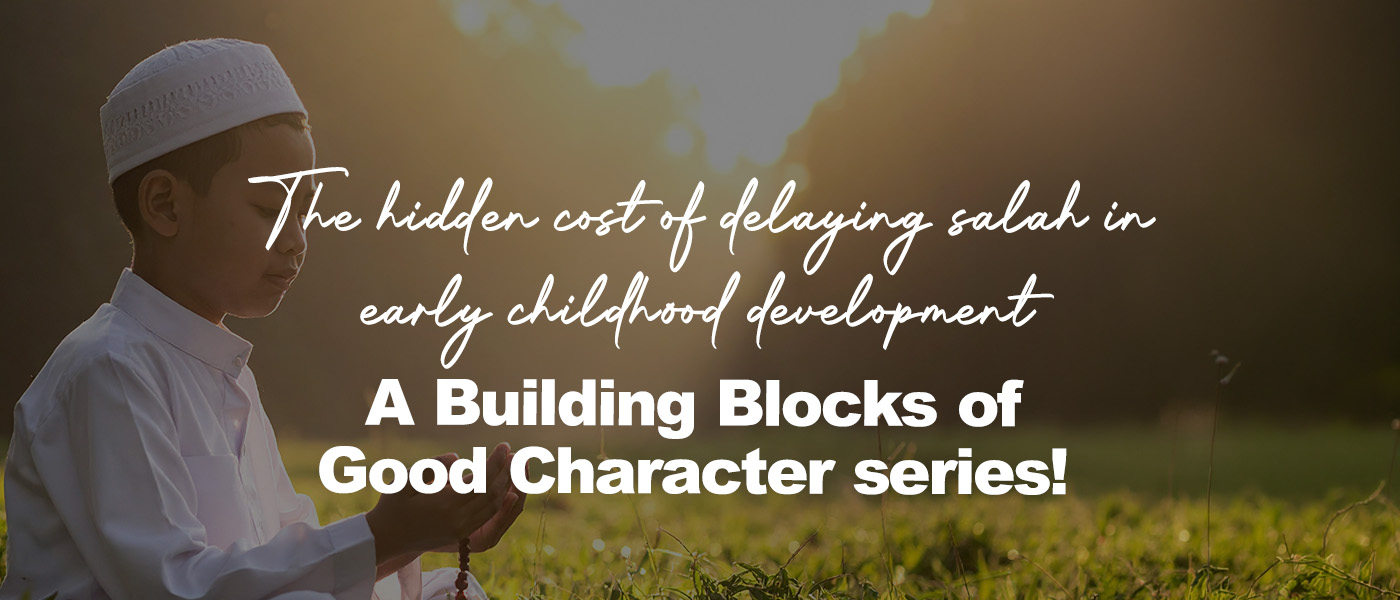
Building Blocks of Good Character is a series focused on the everyday habits that quietly shape a child’s character over time. From prayer and discipline to responsibility, speech, and moral conduct, each article explores how small patterns formed early in life often influence who our children become later on. This series is designed to support parents and educators in recognizing which habits deserve attention early, and how intentional guidance can help raise successful Muslims for the future.
In schools, we often talk about the habits that shape a child’s future, like punctuality, consistency, self-control, respect for others, and the ability to meet responsibility without constant prompting. These qualities do not suddenly appear in adulthood, they are formed quietly, through repeated daily choices, often long before a child understands their long-term significance. For Muslim children, one of the earliest places all of these habits come together is in prayer. What makes salah unique is that it asks for something very specific from us. It asks to pause, to respond, and to do so at a set time, even when something else feels more immediate. A child may be playing, studying, resting, or simply occupied with the ordinary flow of the day, yet prayer introduces an important discipline: not everything should be arranged around convenience. Some responsibilities arrive with their own time and deserve to be met with readiness.
For this reason, the question is not only whether a child learns to pray, but how they learn to treat prayer within everyday life. A prayer performed regularly but habitually delayed can begin to send a different message than we intend. Over time, small postponements can become a pattern, and patterns often shape a child’s understanding of obligation more deeply than occasional reminders do. In family life, delays are often understandable. Homes are busy, routines shift, and parents themselves are managing many demands at once. Yet children are highly observant. They notice what is responded to immediately, what is postponed, and what is treated as flexible. Often, they absorb these lessons without anyone stating them directly.
This matters because children rarely separate spiritual habits from the rest of life as neatly as adults imagine. The way they learn to respond to salah often mirrors how they later approach deadlines, commitments, and responsibilities that require discipline without supervision. For parents and educators, then, this is not simply a conversation about prayer itself, but about the kind of internal habits prayer is capable of building when treated with care from an early age.
In this new series, we – as Muslim educators – explore some negative habits that our children can develop as they grow into adulthood, and how we can combat them early on in their childhood/adolescent years through spiritual habits that encourage them to become the best Muslims, and the best of people among their peers, professionally and academically, too.
What is the significance of salah, and what happens when we decide to delay it and decrease its importance from our lives?
Before discussing the effects of delaying prayers, it is important to remember why salah holds such a central place in a Muslim’s life. Prayer is not simply one act of worship among the many that we are required to do, it is the practice that gives meaning to our mundane days itself. Five times a day, a Muslim is called back to attention towards Allah (SWT). In this sense, salah is not only an obligation, but a repeated training that establishes great discipline, humility, and awareness of Allah (SWT). The Prophet (SAW) has described prayer as the first matter a person will be held accountable for on the Day of Judgment.
In a hadith the Prophet (SAW) has said, “The first matter that the slave will be brought to account for on the Day of Resurrection is the prayer. If it is sound, then the rest of his deeds will be sound, and if it is deficient, then the rest of his deeds will be deficient.” (al-Tabarani). The weight given to prayer in this hadith helps explain why the scholars have always treated a person’s relationship with salah as an indicator of wider spiritual health.
The Quran also draws attention not only to prayer itself, but to how it is treated. Allah (SWT) says, “So woe to those ˹hypocrites˺ who pray yet are unmindful of their prayers […].” (The Clear Quran®, 107:4-5)
Our scholars have explained that this includes those who are careless with prayer, including delaying it beyond its proper time without concern. What is striking here is that the warning is not addressed to those who abandoned prayer entirely, but to those who still prayed while becoming negligent in how they approached it. This distinction is important, particularly when thinking about children and habit formation. A child may appear to be praying, and outwardly that is encouraging, but if prayer consistently becomes something postponed until convenient, the deeper lesson being learned may be that worship can wait until everything else is finished.
The Prophet (SAW) also warned of a time when people would come after the early generations and neglect prayer by delaying it. In The Quran, Allah (SWT) mentions, “But they were succeeded by generations who neglected prayer and followed their lusts and so will soon face the evil consequences.” (The Clear Quran®, 19:59)
The concern here is not simply lateness itself, but what lateness can gradually reflect, and that is, a heart becoming accustomed to placing immediate desire ahead of divine appointment.
Hadith condemning the delaying of salah
- Abu Dharr (ra), a beloved and renowned companion of the Prophet (SAW), once narrated that the Prophet (SAW) said to him whilst striking his thigh, “What will you do if you stay among people who delay the prayer until its time is over?” He said, “What do you command me to do?” The Prophet (SAW) said, “Offer the prayer on time, then go about your business. Then if the Iqamah for that prayer is said and you are in the masjid, then pray.” (Sunan an-Nasa’i)
- The Prophet (SAW) has said, “Between a slave and shirk or disbelief is abandoning the salah.” (Jami at’Tirmidhi)
- The Prophet (SAW) has said, “…negligence is when one does not offer the prayer until the time of the next prayer comes…” (Sunan an-Nasa’i)
- The Prophet (SAW) has said, “This is how the hypocrite prays: he sits watching the sun, and when it is between the horns of [the] devil, he rises and strikes the ground four times (in haste) mentioning Allah a little during it.” (Sahih Muslim)
What happens to us when we begin to intentionally delay prayer?
The consequences of delaying prayer are not always immediate or visible, which is perhaps why the habit can settle so quietly into daily life. A person may still intend to pray, may still complete the prayer itself, and may not initially feel that anything significant has changed. Yet Islamic teaching repeatedly warns that small acts of negligence, when repeated, affect the heart before they affect outward behavior. At the most basic level, delaying prayer means becoming less responsive to one of clearest daily commands from Allah (SWT). In the broader scheme of life, the delaying of prayer can:
- Increase the likelihood of rushing through important tasks simply to complete them.
- Make consistency harder because delayed actions are more vulnerable to being forgotten altogether.
- Reduce the protective role prayer plays in regulating emotions, decisions, and behavior throughout the day.
- Train the mind to negotiate with commitments that were meant to be fixed.
- Weaken a person’s sense of urgency.
- Form the habit of procrastination.
For children, especially, this is important because habits formed around prayer rarely remain isolated. A child who learns that prayer can always be moved later may begin to approach other responsibilities, in school and in life, in the same way. This will not only place the child in great stress in the future, but could also drastically impact their professional and academic performance. This is why timely prayer has always been understood as more than punctual worship. It is daily training in answering what matters before convenience takes over.
Tips from Furqaan Academy Bolingbrook to help parents that are looking to combat this habit
At Furqaan Academy Bolingbrook, we believe in the importance of balancing both the religious and worldly dimensions of a student’s life. As a result, on our school campuses, we take pride that our Islamic institution provides young children and adolescents the space to prioritize their faith with simple actions such as placing Islamic obligations above academic pursuits. For parents who are looking to establish a more successful Islamic lifestyle-centered environment for their children, or Islamic educators looking to bring in more Islamic elements into their classrooms, here are some of our helpful tips to instill qualities of success into our students and their shared spaces:
- Pray regularly in your homes. Children are far more influenced by what they regularly see than by what they are occasionally told.
- Do not present prayer as something that happens only when unimportant tasks are finished.
- Use calm reminders instead of fear-mongering tactics and repeated pressure. We want our children to love Allah (SWT) and be close to Him.
- Acknowledge the efforts of your children. If you see them praying on them, praise them for the excellent effort!
- Have discussions about the importance of prayer. Children always respond better when they learn of the significance and purpose behind an action.
On our school’s campus, more than 230 students have daily access to dedicated prayer spaces such as a musallah for boys, and a separate musallah or girls. This is an intentional part of our school environment to ensure that students do not simply learn about salah in theory, but experience what it means to pause for prayer within the rush of a full school day. However, sustaining this work requires community support, and every contribution helps us continue building an environment where Islamic practice is taught not only in lessons, but through daily experience.
Dua
O’ Allah (SWT)! Make us and our children among those who establish prayer and guard it carefully in its proper form.
Place in our hearts and in the hearts of our children a love for obedience to You and eagerness toward what pleases You.
Make our homes and our schools places where prayer is honored and where a generation is raised upon faith, righteousness, and steadfastness.
Ameen!